"In Frostreach Territories, cold bites like iron, breath freezes, blood grows heavy. Tundra stretches wide, its silence broken by wind’s grim song and Winter Wolves prowling, eyes sharp as blades. Hrimduraz Hothkarls druids murmur to frost spirits, their fires dim against the dark. Kratophoönminotaurs stalk highlands, axes honed by hate. The Iron Oubliette stands, black stone holding cries of the damned. Dún Briste's ruins whisper of lost pride, banshees keening. Walk wary, stranger—be clad in Yeti fur, bear fire within. Ice claims the weak."
The Frostreach Territories constitute the vast, ungoverned northeastern frontier of the continent of Tessix on the world of Lillowen, a merciless expanse of eternal ice, storm-scarred tundra, and magically volatile crystal fields that defies all attempts at lasting conquest or settlement. No crown, empire, or creed has ever maintained dominion here for more than a single turning of the seasons; the land itself rises in rebellion through continent-spanning blizzards, creeping glaciers that entomb entire hosts, and raw arcane currents that punish hubris with explosive backlash. Warmth is a rarer treasure than gold, found only in jealously guarded volcanic springs or purchased at the price of blood and oaths. This is a region where the environment is an active, malevolent participant in every story told within its borders.
To the civilized realms of the south and east, the Delphin Vale of the Maldovarrian Colonies, and distant Bast-Neferrah to the west, the Frostreach is known simply as the Frozen Grave, a byword for certain death and vanished ambition. Even the blasted wastes of the Kurgan Expanse considers it a miserable region best avoided. Outsiders regard it with visceral dread: a cursed wilderness where the ice is said to trap every scream forever and the brilliant auroras are woven from the souls of those who dared too much. Expeditions sent northward—whether imperial surveys, merchant caravans, or crusading armies—rarely return, and those few survivors speak in haunted fragments of a place that demands savagery as the price of continued existence. Yet this same reputation exerts an almost magnetic pull on the desperate and the ruthless: exiles fleeing justice, relic-hunters chasing the wealth of pre-cataclysm empires, and would-be conquerors hungry to forge legends from frost and bone. For the bold or the broken, the Frostreach represents both ultimate erasure and the last untamed proving ground on Lillowen. A perilous prize where power belongs solely to those strong enough to seize and hold it amid nomadic giant-kin, monstrous clans, reclusive druidic circles, ancient draconic presences, and the ever-present pall of spectral curses. To enter is to gamble one’s life and soul against a land that has never yet lost.
Rumors & Adventure Seeds in the Frostreach Territories
Travelers, trappers, and half-mad survivors on the edge of **Frostreach Territories** whisper the following tales:
• A Vyrel Exiles caravan vanished near Sylvarith, leaving only crystal shards weeping liquid aurora; retrieving their smuggled Zyralith Krag could tip the balance between Gorzha Kul hobgoblins and Kratophoön minotaurs, but whose side do you choose?”
• The ice in Kryzvaren Depths now exhales visions of unlived lives, luring miners to their doom; a party delving for the Frozen Archive’s lost scrolls might silence the whispers with a forgotten Ionis rite, if they resist the madness.
• Black ice bergs from Glacial Abyss drift into Icebreaker Bay, carrying frozen screams that age sailors overnight; destroying the source in Hrimvarg Lair might require bargaining with chained Frost Wraiths, risking your own years.
• Sylkar Renn offers amnesty to any who retrieve a banshee-tainted relic from Dún Briste for his Kryzva Shal flotilla; the artifact could calm Sahuagin Depths tides, but its choral curse drives bearers to betray their crew.
• Frostveil Rift exhales thicker corpse-mist, birthing Frost Wraiths that whisper Corvethia’s secrets; harvesting their essence for Glacier Moss potions could heal the plagued Zylvara, but the mist now twists the living into wraiths mid-harvest.
• A child in Theragos Pelaga heard Valkara’s voice in the steam vents, promising to end the blood-drought if her faithful retrieve a lost Iceshard Lily crown from Vylthryma Veil; the druids guard it fiercely, forcing a choice between theft or divine wrath.
• The Crystal Tundra has begun singing a new, lethal chord; Vyrel Exiles in Vyralthar claim the only way to silence Sylvarith before it flays half the territories is to return a single drop of true dragon blood—Glongus’s own.
• The ice itself has turned traitor in Icewind Reach—mirage-oases now collapse into bottomless voids that swallow entire Loxodon caravans; Thora Thrygardus seeks guides who can read the new groans before Kragthar Vuhn starves.
• A charred map found on a frozen corpse points to a hidden vault beneath Frostfang Citadel where Arcadomalda automatons guard a single Everfrost Pine seed that could regrow Winter’s Embrace tenfold—if the guardians don’t grind the thieves to red frost first.
• Korzha Veld of Gorzha Kul quietly hires blades to escort a crystal caravan through The Frozen Grove, promising double pay in Zyralith Krag, yet every escort who accepts vanishes without trace—some say the hobgoblins feed southern mercenaries to Baphomet to strengthen their altars.
• The Kryzvaren Depths have begun exhaling rime that ages flesh a century in heartbeats; a single Iceshard Lily plucked under triple moons and offered to the breathing walls is said to seal the breach forever, but the lilies now bloom only inside Vylthryma Veil, and the Hrimduraz Hothkarls kill any who trespass.
• Zyrel Vyrel has placed a bounty on the head of Eillynn Belvione, the warden of The Iron Oubliette, payable in southern titles and a ship of black ice—yet half the hunters sent north return as smiling statues, their faces locked in betrayal.
• A blind yakfolk from Theragos Pelaga whispers that the Zaratan beneath the continent stirs again; the only way to lull it back to sleep is to sink seven living hearts—each from a different ruling bloodline—into the boiling vents of Icebreaker Bay before the next crimson moon.
• Lyrva Khel of the Frostveil Shroud seeks outsiders foolish enough to infiltrate Varnthok and steal the hobgoblins’ sacred spiked mace of Malkan; return it unharmed and the shifters will reveal a safe path through the migrating ridges that no map has ever held.
• The Dún Briste banshees sang a new verse last night—clear words promising that whoever returns the stolen crystalline tablet from Glongus’ Lair will learn the true name that can bind the dragon forever… or wake him instantly and inherit his frozen empire.
Geography and Landscapes of the Frostreach Territories
The Frostreach Territories sprawl as a colossal, interconnected wound of ice and fury whose every feature conspires against the living as the land itself wages ceaseless war against permanence. In the far north, sapphire glaciers taller than any citadel calve icebergs the size of towns into black seas, their collapse sending tremors eastward that fracture distant plateaus and southward that bury meadows beneath sudden white graves. These same shocks feed hidden volcanic fissures beneath the ice, exhaling scalding plumes that freeze instantly into glittering shard-clouds carried hundreds of miles by screaming winds. Central crystalline plains of flawless black ice pulse with raw arcane veins that sing beneath the surface, every harvested shard triggering auroral gales that spiral outward for weeks, twisting mirages across the tundra and shattering spells as far south as the meadows. Storm-lashed bays and obsidian skerries channel offshore blizzards inland through cliff funnels, while wind-carved ridges migrate nightly, erasing trails and birthing new crevasses that swallow herds whole. Fractured eastern highlands rain avalanches onto lower reaches, and deceptive southern meadows—seemingly gentle—hide drowned caves fed by northern melts. Volcanic steam, seismic ripples, and leaking ley lines bind every subregion together into one predatory organism. A tremor in the Glacial Abyss can bury a camp in Icewind Reach within hours, an arcane surge in The Crystal Tundra can blind travelers in The Frostclaw Highlands with false warmth, and a single offshore storm can scour the entire mainland clean of footprints before dawn. Western glaciers spill avalanches that render passes into Bast-Neferrah impassable for entire seasons, while arcane storms drift southward into The Kurgan Expanse and Delphian Vale, contaminating border rivers with shards that twist magic for weeks.
Survival is bargained from a land that hoards every necessity and demands blood for the loan. Breath itself crystallizes in lungs when the temperature plunges, halting blood mid-vein unless warmth is seized from rare volcanic springs or fleeting bindings with chained frost spirits. Flaying gales descend without warning, stripping flesh in minutes unless shelter is clawed from living ice before the wind hunts movement. Arcane surges from living crystal shatter spells and twist compasses into mocking laughter, rendering magic a lethal gamble. Corpse-mist exhaled by breathing rifts ages flesh a century in heartbeats, glass-needle hail slices exposed skin to ribbon, and mirages of sunlit hearths collapse into bottomless crevasses that swallow the hopeful whole. The ground can drift nightly beneath powder deep enough to bury cathedrals, with safe passage read only in faint starlight or the ice’s own treacherous groans. Even in the most temperate areas of the region light is harvested from glowing spores at the price of hallucinatory death. Here, water freezes upward into spears that impale the unwary, and every hidden spring is contested by predators drawn to the only warmth for a hundred miles. Heat, water, light, navigation, and magic itself are transformed into mortal trials. No resource is given freely, and the smallest misstep invites the land to reclaim what little life has stolen from it.
Notable Sites
Glongus’ Lair (Frostspire Skerry): A cathedral of rune-chained black ice where the ancient white dragon Glongus slumbers; disturb the bindings and the entire island shudders, exhaling memory-freezing breath that leaves explorers weeping for unlived childhoods.
Sylvarith (Crystal Tundra): A perfect circle of crystal trees weeping liquid aurora, guarded by midnight blood-rites; a single untithed shard triggers a chord that ruptures ears and births flaying gales across half the territories.
Frostveil Rift (Frozen Grove): Mile-long wound exhaling corpse-mist that births new Frost Wraiths each new moon; step inside and age a century with every breath, as spirits drag the living below to drowned relic depths.
Vaeloria Grove (Icewind Reach): The only living green in an ocean of white, its hidden volcanic hot spring guarded by storm-wards; defilers are slain to preserve the only true warmth for a thousand miles.
Vryndral Cove (Icebreaker Bay): Half-submerged sea-cave of whale-bone arches where frost spirits are summoned with shipwrecked souls; a single wrong word turns the tide to knives of ice.
Hrimvarg Lair (Glacial Abyss): Blood-ice cathedral cavern where Frost Wraiths are chained to altars; whispers sharp as knives flay flesh from those who break the pacts bargained for survival.
Travel & Environmental Hazards in The Frostreach Territories
** Movement Across the Region**
A hardy traveler on foot, unburdened and pushing hard under clear auroras, rarely covers more than eight to ten miles before nightfall forces a halt. Snow depth varies from waist-high powder to wind-crusted ice sharp enough to slice boot leather, while nightly drifts erase every trail and migrate entire ridges. Sleds pulled by mammoth or reindeer can triple that distance on known migration paths, but horses founder within days, their lungs filling with ice crystals, and wheeled vehicles are useless against bottomless crevasses and sudden shear drops.
** Essential Gear Without Which Death Is Nearly Certain**
• Multiple layered furs with a windproof outer mantle of treated sealskin or woolly mammoth hide
• Snow goggles carved from bone or smoked crystal to prevent snow-blindness
• A sturdy ice-axe and crampons for crossing glare ice and hidden crevasses
• A sealed oil lantern or whale-oil torch plus spare fat, for the long polar nights devour light itself
• Heavy mittens sewn to a cord through the sleeves, lest numb fingers drop a blade or freeze solid in moments
** Daily Threats to Body and Mind**
• Breath freezing in the lungs on the coldest nights, halting blood flow and blackening fingers in heartbeats.
• Flaying winds that strip exposed skin to raw meat in under an hour if shelter is not found.
• Sudden mirages of warm hearths or lost loved ones that lure travelers into open ice until they freeze smiling.
• Hallucinatory exhaustion from lack of true darkness or light, breaking minds with endless auroras or starless nights.
• Frostbite that creeps unnoticed beneath furs, turning limbs black before pain ever registers.
** Seasonal or Sudden Weather That Changes Everything**
Without warning—sometimes in minutes—the sky can fall silent and the world turns white as continent-spanning blizzards descend, the kind locals simply call “the wind’s hunger.” Visibility drops to arm’s length, sound dies beneath the roar, and movement becomes a blind crawl; a party caught in the open is buried alive or flayed to bone before the storm passes hours or days later. These whiteouts strike year-round but grow longest and fiercest in deep winter, arriving with no more omen than a sudden drop in temperature and an eerie stillness that veterans dread more than any howl.
** Water and Sustenance Rules**
Water must be melted from scooped snow or ice over a sealed lamp—never eaten cold, for it steals body heat faster than it quenches thirst. A grown warrior needs at least four quarts melted daily, more when laboring; open water is almost unknown except at rare volcanic springs guarded jealously. Food is pemmican, blood sausage, or frozen reindeer meat carried in plenty, for hunting is unreliable when herds vanish into whiteouts and fish freeze solid the instant they leave the hole. Eating snow without melting first invites death by inner chill, and trusting any surface ice risks breaking through into black water far below.
** Special Dangers Unique to This Land**
• Ground that shifts and groans nightly, hiding new crevasses beneath a flawless crust of snow.
• False warmth that blooms suddenly in the air, tempting travelers to shed furs before the cold returns tenfold.
• Tracks and landmarks erased by morning, turning even expert guides into lost wanderers.
• Thin ice over volcanic vents that looks solid yet drops the unwary into scalding water instantly frozen around them.
The Glacial Abyss is a single, unending wound carved so deep into the world that the sky itself shrinks to a pale, unreachable scar between sapphire walls veined with frozen lightning that crackles like captive storms; cliffs of living ice tower thousands of feet, their faces scarred by avalanches that cascade in an eerie, lethal hush while the air crystallizes in the lungs and every footstep rings across unseen crevasses like a funeral bell tolling over black, corpse-lit water far below. Frost mirages bloom and die in heartbeats (warm hearths, laughing children, sunlit meadows) only to collapse into yawning voids that swallow the hopeful whole, and The Kryzvaren Depths exhale rime so cold it halts blood in its flow, birthing pale ghosts that spiral upward in endless, whispering spirals. Half-swallowed on one impossible wall hangs Durgan’s Lament, an ancient dwarven city of exiles encased in glacier, its sulfurous forges still burning orange against the blue, belching screaming faces of heat; the Hrimduraz Hothkarls Druids chain Frost Wraiths inside the blood-ice cathedral of Hrimvarg Lair, trading memories in whispers sharp enough to flay flesh from bone; Ghorza’kraul Minotaurs descend on chains of frozen sinew to drag captives to altars that turn flesh to ice in an instant, leaving paralyzed victims as shattered remnants of agony. Shifters ghost between crevasses bartering Glacier Moss that burns the tongue and bear-hearts that beat once per day; feral werewolves and wereboars hunt the lightless tunnels while solemn Goliath and lawful werebears with frost-rimed fur, stride the upper ledges beside druids whose single roar triggers silent avalanches that bury the unworthy without sound or mercy; at the rim, crystalline Iceshard Bears patrol with footfalls that chime like cathedral glass, exhaling diamond dust that hangs lethal and glittering; and high on a wind-lashed shelf the Yakfolk village of Theragos Pelaga huddles in domes of mammoth bone and steaming yurts, the only warmth for a hundred miles sold by the ounce of blood or shard of Zyralith Krag, because in The Glacial Abyss the ice stands as an unchanging guardian, hoarding every cry in its frozen core, awaiting the moment when another life yields to its relentless hold. The Glacial Abyss is bordered on the south by the impassible heights of The Ironforge Mountains, and shares a small western border with the isolationist nation of Bast-Neferrah, though the same mountains render this border merely a line on a map with no real passage. Its northern coastline is a treacherous and rocky ice cliff face, making landing impossible except in its eastern neighbor, Icebreaker Bay. Its southeastern border touches the The Crystal Tundra, where prisoners to The Iron Oubliette make their grim pilgrimage.
Kryzvaren Depths (Starlight Labyrinth): Gem-rich labyrinth lit by frozen lightning and dripping aurora. A single wrong turn ages the traveler a hundred years or drops them into lightless void forever.
Durgan’s Lament (Exiled Dwarf Colony): Named "Sorrow of the Deep" in Dwarvish for their forced exile from Haltodor due to clan disputes, this half-frozen dwarves’ forge clings to an ice wall. Its forges glowing red against the blue, while madness and ancestral shame besiege the exiled inhabitants sent from Haltodor in shame.
Frostspire Skerry rises in the northern sea as a forsaken relic, its cliffs lacquered in black ice that swallows the aurora and bleeds it back in venomous greens and bruised purples. No hull survives the kiss of its submerged stone fangs without shrieking, and the gales themselves are a choir of the drowned singing in perfect, impossible harmony that crawls inside the skull and nests there forever. The shattered spires of Dún Briste claw through perpetual fog, a city betrayed and murdered in one cataclysmic night; its Banshees do not wail—they weave choral curses so exquisite that climbers smile at visions of long-dead lovers while stepping willingly off the cliffs into the waiting jaws of the sea, their final notes joining the endless song. Relics within—crystalline tablets that whisper futures, frost-forged blades that drink warmth—draw foolhardy scavengers, but the ruins’ wards twist time itself, aging intruders decades in heartbeats until they crumble to glittering dust the wind carries away like snow. Beneath the city yawns Glongus’ Lair, a cathedral of black ice veined with blue-white dragonfire where the Ancient White DragonGlongus slumbers behind rune-chains that bleed living frost when strained; his exhalations crystallise memory, leaving explorers weeping for childhoods they never lived. On the highest crags bloom the Iceshard Lily, petals chiming like shattered crystal bells—pluck one and Valkara answers with a storm that strips flesh from bone in heartbeats and buries the cries in absolute quietude. Skrymvind Hold, a ring of blood-blackened standing stones, stands sentinel where occasional Hrimduraz Hothkarls druids brave the crossing to spill reindeer blood every new moon, renewing bindings lest the dragon wake and shake the entire Frostreach Territories. On the leeward cliffs clings Zhak’gar Vhul, a ragged Hobgoblin reaver camp of wind-ripped tents reeking of salted banshee-meat and stolen relics, their shamans bargaining with the dead while picking Dún Briste clean. Frost Wyverns dive from cliff hollows with breath of glass needles; feral weretigers slink through fog, amber eyes glowing as they ambush lone hobgoblins for scraps. The skerry’s vast interior—black-pebble beaches and frozen lagoons—resists mapping, its curses echoing to Icewind Reach where banshee wails ride northern winds. Enduring the skerry calls for storm-proof hides and silent steps; the skerry endures as a living curse—beautiful, isolated, ravenous—a colossal frozen island where every shadow hides betrayal, and the ice claims all who linger.
Dún Briste (Ancient Ruins): Crystalline spires of a betrayed city rising from black ice; banshees weave choral curses so exquisite that climbers leap happily into the sea, their final notes joining the eternal song while relics twist time itself, aging intruders to dust in heartbeats.
Zhak'gar Vhul (Hobgoblin Reaver Camp): Wind-lashed tents clinging to the cliffs, filled with looted and the smell of banshee-tainted meat taken from battling Hrimduraz Hothkarls and Shifter traders
Icebreaker Bay is a storm-ravaged crescent where the ocean claws endlessly at the land: icebergs calve from The Glacial Abyss tremors and drift like siege towers, undersides glowing with trapped phosphorescence, while volcanic vents bubble scalding plumes that boil flesh before the cold seals the wound in ice. It is located east of The Glacial Abyss, south of Frostspire Skerry, west of Icewind Reach, and North of The Crystal Tundra. Waves crash black and foaming, laced with Zyralith Krag sparks that arc like living chains, unmaking hulls in flashes; Sahuagin hordes from The Sahuagin Depths harpoon survivors, dragging them into submerged lairs festooned with sailor-bone trophies. The Shattercliff looms with beaches of volcanic glass that slice feet to ribbons, littered with wrecks where frozen corpses clutch useless maps. Kryzva Shal, a floating warren of lashed hulks and iceberg caverns, serves as the bay’s beating heart—pirates here trade in memories and fingers, lords rising and falling with each crimson moon, their figurehead thrones overlooking a market that never sleeps. Tabaxi and Leonin fishers ply eastern shoals, hauling Icebreaker Cod and Arctic Furs for yearly caravans to Bast-Neferrah, the isolationist feline nation to the west, their nets dodging Wyvern dives from above. No entrenched druids; but occasional Hrimduraz Hothkarls pass through for sea-rites at Vryndral Cove, a half-drowned shrine of whale-bone where frost spirits rise, but they avoid lingering amid the chaos. Temporary Hobgoblin raiding camps from The Frostclaw Highlands dot the leeward shores, ambushing fishers before retreating upland, while fleeting lycanthrope packs—mostly wereboars—raid from fog-bound coves, pillaging wrecks for survival before vanishing south. Frost Wyverns dominate the skies, nesting in cliff hollows and exhaling glass storms on intruders. At night the bay glows from beneath, a vast mirror of drowned faces mouthing silent pleas; ghost-light leaks from cracks in the seafloor, painting the waves in corpse-green, and every tide brings fresh corpses frozen in attitudes of prayer. The currents themselves are treacherous, dragging ships toward hidden riptides that spit them out weeks later on Icewind Reach beaches, half-digested by Sahuagin. Navigating the bay requires stout ships and keen instincts; the bay is a lawless crucible—ravenous, ever-shifting—where every tide washes in new graves, and the water echoes the names of the drowned until you join their eternal refrain.
Shattercliff (Black Sand Beach): A shore of razor-sharp volcanic glass and frozen corpses, picked clean by pirates, Sahuagin and Frost Wyverns.
Sahuagin Depths (Sunken Graveyard): A maze of drowned hulls and sunken treasures where Sahuagin string harpoons with sailor-bone and guard chests that still drip seawater.
The Icewind Reach is an endless white scream where the horizon devours itself nightly. Knife-edged snowdrifts and wind-carved ridges migrate like living things, erasing every trail, every grave, every prayer beneath fresh powder that conceals crevasses deep enough to swallow cathedrals whole. The gales themselves are predators—razor winds that flay skin from bone in minutes and carry the resound of every soul the tundra has ever claimed, echoing names until the living murmur back in their dreams. Icewind Reach is to the south of Frostspire Skerry, and the northernmost mainland region of The Frostreach Territories. It is to the east of Icebreaker Bay, to the north of The Frozen Grove, and to the west (though truly more northwest) of The Frostclaw Highlands. Frosthorn Reindeer herds thunder across the ice like constellations torn loose from the sky, antlers glowing with stolen aurora light, pursued by Winter Wolves whose breath crystallises blood mid-vein into ruby hail. Mirage-oases bloom on every horizon—golden lakes, warm yurts, laughing kin—only to fracture into yawning rifts lined with mirrored knives when approached, swallowing sled, rider, and hope alike. The Skolthar Rift splits the plain like an unhealed wound exhaling corpse-warm mist, birthing Frost Wraiths that rise on columns of grave-fog to drain the last heat from still-beating hearts. The Loxodon clans of Kragthar Vuhn and Thulgrim Vok rule this emptiness, guiding vast woolly mammoth caravans beneath towering yurts of hide and tusk pitched for one night only, their deep-voiced shamans chanting to Valkara for safe passage across a land that forgives nothing. At the heart stands The Vaeloria Grove, the only stand of living trees for a thousand miles, roots drinking from a hidden volcanic spring; here the majority of Loxodon tusk-guardians gather with Hrimduraz Hothkarls Druids, weaving storm-wards and blood-rites to calm blizzards and guard reindeer migration paths from over-hunting. Nomadic Shifters shadow the herds for fur and bone trades, bartering at fleeting camps before vanishing south, always watching for the suspicion that links them to lycanthrope kin. Feral werewolves strike from drift-lairs buried beneath the snow, pillaging supplies and fleeing before druid storms descend, never bold enough to hold ground in the open. Occasional weretiger raids spill from southern wilds, pillaging for herbs before vanishing. No minotaurs or hobgoblins dare permanent footholds—the vastness exposes armies like insects—but raids from Frostclaw Highlands spill across the border when herds grow fat, clashing with Loxodon guardians in brief, bloody skirmishes over migration routes. The reach’s colossal flats shudder with deep tremors from the abyss, calving bergs into Icebreaker Bay and drawing opportunistic wolf packs seaward. Survival demands star-navigation, blood-offerings to the wind, and the certainty that every footprint is a wager; the tundra is the eldest hunter—vast, luminous, merciless—preserving every cry in faint, stratified resonances for the next wanderer foolish enough to believe silence is safety.
Skolthar Rift (Breathing Wound): A mile-long breathing wound exhaling corpse-warm mist that births Frost Wraiths. Avoided by Shifter traders, It's warm death-smelling air lures the daring and foolish downward to drowned relics in tunnels lined with mirrored knives.
The Frostclaw Highlands are a brutal, broken crown of shattered plateaus and knife-thin ridges where stone and ice have fused into a single weapon. Avalanches fall in a roaring cacophony, burying entire warbands mid-scream while the ground itself shudders with deep, ancient tremors that split open fresh chasms and swallow hundreds in a heartbeat. The Frostclaw Highlands is the furthest east region of The Frostreach Territories, with The Frozen Grove and Icewind Reach to the west. It has some trade with The Delphian Vale of The Maldovarrian Colonies, though its access is limited by the small border the subregion shares with its western neighbor. Frost Salamanders coil in mist-belching grottos, their scales chiming like breaking cathedral glass as they exhale auras so cold they freeze hearts solid mid-beat; solitary Hill Giants stride the highest shelves, laughing in thunder that triggers fresh snow-death while hurling boulders the size of cottages at anything that moves. Everfrost Pine groves cling to impossible ledges, pale trunks worth kingdoms to southern shipwrights—Gorzha KulHobgoblin loggers descend in iron-disciplined columns, saws screaming as they strip the heights, only to be met by Kratophoön Minotaurs charging across the flats in blood-painted fury, horns lowered, dragging screaming captives back to their camps outside The Frostfang Citadel where altars drink living heat and leave only agonized effigies locked in eternal torment. Tough goliaths of Vornhild Krag hold a sky-hold of stacked stone and mammoth bone on an unreachable plateau, reachable only by cliff-ropes or death; from its walls they rain avalanches and war-arrows on besiegers, calling in rare werebear allies from Icewind Reach when the horns sound thrice. No shifters or exiles dare permanent camps—the danger is too pure—but feral wereboars and weretigers raid in savage mixed packs, pillaging timber camps for meat and tools before melting back into neighboring tundras when the horns of Vornhild answer. Frostfang Citadel squats on a cliff-tooth, gates opening only when fresh blood freezes on the threshold, its ancient Arcadomalda Empire automatons still march in endless patrols that grind intruders to red frost. Iceshard Cavern glitters like a dragon’s hoard but sings a high, sweet note seconds before collapsing, entombing miners and monsters in perfect crystal sarcophagi. Thrymgor Kravos, a half-buried Frost Giant vault, leaks flaying winds that peel skin from bone and guards weapons tall as pines. The highlands’ vast, fractured expanse fuels endless raids spilling westward, where hobgoblin axes seek untouched groves and minotaur horns seek fresh skulls. Those who call it home quickly learn to use cliff-ropes, war-horns, and have the willingness to die on the plateau they were born to defend; the highlands are a crucible of endless feud—rugged, blood-soaked, unforgiving—where every ridge is a throne seized in combat, and the cliffs resound with every fall, fueled by insatiable appetite.
Frostfang Citadel (Clifftop Ruin): automaton-haunted fortress): Ancient Arcadomalda Cliff-carved fortress ruin where homicidal constructs still patrol its gates, which open only for frozen blood. Minotaur zealots and relic-hunters camp in its shadow, gambling their lives for the clockwork guardians and frost-giant blades within.
The Frozen Archive (Library-Sanctuary of Ionis): Vast, vaulted fortress of black ice and rune-etched stone hidden amongst an isolated crag. It's scribes in heavy robes copy crumbling scrolls by whale-oil lamps, guarded by dark armored wardens and wards that turn blizzards against intruders, sacred to the followers of Ionis, goddess of knowledge and binding words.
Iceshard Cavern (Collapsing Gem-Vault): A glittering gem-rich tomb that sings when it falls, swallowing miners and monsters alike. guarded by **Hobgoblins**from thieving Shifters.
The Crystal Tundra is a frozen mirror shattered by divine wrath. Zyralith Krag spires erupt like jagged lightning frozen mid-strike, some taller than any castle keep with their facets pulsing a raw arcane fury that twists spells into lethal backlash, shatters steel mid-swing, and spins compasses into mocking laughter. The ground is flawless black ice over living crystal veins. Here, every bootfall rings like a cathedral bell tolling judgment and the air tastes of ozone and old blood. Harvest a shard without the proper blood tithe and the entire plain answers with a single, perfect chord that ruptures eardrums and births flaying gales that strip flesh in perfect ribbons. The Crystal Tundra is the southernmost subregion of The Frostreach Territories, sharing most of its border with The Kurgan Expanse to the south, though its mountainous terrain makes travel nearly impossible. It accesses Alder's Reach of the Delphian Vale via its southeastern border. the Glacial Abyss lies to its northwest, Icebreaker Bay to its north, Icewind Reach to its northeast, and the Frozen Grove to its east. Vyralthar, the Vyrel Exiles’ ramshackle city of silk tents and wraith-cloaks, sprawls across the southern flats. The Exiles are smugglers who move like living shadows, cutting throats for a single glowing fragment worth a kingdom south of the frost. At the heart stands Sylvarith, a perfect circle of crystal trees weeping liquid aurora, guarded by Hrimduraz Hothkarls Druids whose midnight rites are the only thing keeping the tundra from exploding into an arcane inferno that would devour half the Frostreach. Varnthok, a Hobgoblin guarded crawling tent-city on sled-runners, migrates relentlessly, its phalanxes stripping spires with mechanical precision and clashing nightly with exile assassins over the richest veins. Nomadic Shifters skirt the edges in wary family bands, trading furs for shards without ever daring to settle. At scattered outposts like Varnthok, shifters and wanderers meet in wind-battered bone-and-hide structures for tense barters. Feral werewolves and weretigers strike in lightning raids, pillaging camps before vanishing into mirage—no lairs, only frozen claw-marks and screams echoing in the spires. Beneath lie the Frostspire Vaults, doors sealed by riddles that burn the tongue and stop hearts mid-word, guarding gems that sing madness in frequencies only the dead can hear. Occasional minotaur warbands spill from the Frostclaw Highlands, only to be cut down by hobgoblin crossbows in the open. The tundra’s vast, humming expanse bleeds raw magic westward, twisting forest paths into loops of madness. Survival demands blood-offerings, silence, and crystal-tuned compasses; the tundra is a sentient forge—luminous, treacherous, eternally starving—where every reflection shows your death, and the spires capture every spilled drop in vibrating unison.
Zyralith Krag (Singing Spires): Arcane-charged Towers of living crystal that demand blood for safe passage, their energies disrupting spells and their song driving the unworthy mad.
Frostspire Vaults (Buried Vaults): Ice-sealed doors that open only for those who speak the language of dying stars. It's Gem filled caverns are haunted by frost mirages, raided by Lycanthropes and coveted by exiles.
Vyralthar (Exile Settlement): The camp of the notorious Vyrel Exiles, smuggling crystals, battered by tundra storms, rivaling Minotaurs.
The Frozen Grove is a silver sea of ice-grass that winter forged into weapons: every blade a needle of frozen glass singing like a drawn dagger when the wind hunts across it, while Iceshard Lily opens only under the triple moons, petals chiming like cathedral bells of knives that ring warnings for miles across the empty flats. The ground is a treacherous mosaic of frozen rivers and sudden sinkholes plunging to black, drowned lakes where corpses still reach upward with perfect, pleading hands locked mid-prayer. The Frozen Grove shares its entire southern border with the Delphian Vale, serving as the main thoroughfare for traders, explorers, prisoner transport convoys, and potential invaders. To its north is The Icewind Reach, to its west the Crystal Tundra, and to its east the Frostclaw Highlands. While still cold, arid, and mostly inhospitable, it offers the most tolerable climate in the Frostreach Territories. Frost Wraiths drift between the stalks as living fog, their touch ageing flesh a century in a heartbeat and leaving only statues of screaming frost the wind slowly erodes into glittering, lethal dust. The permanent Shifter settlement of Zylvara sprawls in yurts, bone racks, and sledges on the only stable ice for a hundred leagues, its markets alive with trade in lily, Glacier Moss, and wraith-bone beneath watchful beast-eyes that scout every horizon. Tangled groves of Everfrost Pine giants rise here, needles singing in gales like drawn daggers, their sap forming lethal garlands; ancient wards twist paths into temporal loops, while Vylthryma Veil fungi glow, spores luring victims into blood-drinking sinkholes. Frostclaw Lynx and Emberclaw Fox prowl, adding to the feral dangers. Strong Hrimduraz Hothkarls circles dominate glades, tending Arctic Sage, and Centaurs from Elarin-Astralith gallop clearings, their star-tattoos guiding rituals. Goliath hunting camps like Hrimskal Camp dot the flats like temporary fortresses of hide and tusk, fires burning blue as they butcher Frosthorn Reindeer beneath the auroras, bone tools clashing with shifter barters over migration paths and water rights in endless, quiet wars of survival. The strongest druid presence in the Territories gathers at Winter’s Embrace, a single living grove whose roots drink from a hidden volcanic spring, bleeding sap warm as blood and leaves that burn with blue flame yet never consume; here Hrimduraz Hothkarls weave rites to calm blizzards, aided by occasional Goliathwerebears summoned from Icewind Reach whose roars alone can silence a storm. Feral wereboars and werewolves pillage in packs, ambushing traders without bases and fleeing south to the Kurgan Expanse when hunted. No hobgoblins or minotaurs hold ground—the openness thwarts forts—but raids from the Frostclaw Highlands spill south when herds are fattest, contesting reindeer paths with fire and steel. Frostveil Rift, a mile-long wound exhaling corpse-mist, births new wraiths every new moon, dragging the living below. The grove’s expansive meadows absorb arcane leaks that make lilies bloom brighter and deadlier, drawing ever more shifters. Survival demands light steps and lighter offerings; the grove stands as a vigilant outpost—resilient, luminous, unforgiving—its blades inscribing traces of violation, as the winds deliver condemnations across its relatively milder expanse.
Hrimskal Camp (Goliath Hunting Camp): A semi-permanent camp of hide tents and bone racks, where Goliaths butcher reindeer beneath the auroras. They often clash with Lycanthropes and Hobgoblins.
Vylthryma Veil (Glowing Fungus Sea): A bioluminescent expanse where spores birth waking dreams; step wrong and live your own death a hundred times.
Elarin-Astralith (Centaur Star-Circle): A clearing open to the sky where Centaurs read the future in the auroras, raided by Hobgoblins for timber.
Zyrmathis Hollow (Shifting Grove): Trees of living ice that rearrange themselves nightly, trapping intruders in ever-tightening rings.
Population and Demographics of The Frostreach Territories
Fewer than twenty thousand souls endure the unrelenting cold of the Frostreach Territories, a number that rises and falls with every killing blizzard or brief summer thaw. Permanent settlements are almost unknown; most inhabitants live as nomads, exiles, or raiders, moving ceaselessly with Frosthorn Reindeer herds, drifting wreck-flotillas, or migratory sled-cities across the vast white emptiness. Births are rare, and infant death is common, while sudden avalanches, wraith-drain, or sacrificial altars claim far more lives than old age ever manages.
The frozen north belongs chiefly to towering Goliath clans and their stoic Werebear kin, whose massive frames and thick hides let them stride the open tundra and high ridges of Icewind Reach and The Frostclaw Highlands where lesser folk would freeze mid-step. Iron-disciplined Hobgoblin warbands form the second great presence, clinging to timber-rich plateaus and crystal fields wherever defensible stone or black ice offers purchase. Wary Shifter clans—forever suspected of feral were=blood gather in scattered family bands around the milder meadows of The Frozen Grove and the hidden volcanic springs guarded by the Hrimduraz Hothkarls. Smaller yet fierce numbers of Minotaur zealots, Loxodon herders, Yakfolk traders, and desperate Human, Tabaxi, and Leonin exiles endure in isolated pockets, while feral Werewolf, Wereboar, and Weretiger packs haunt shadowed crevasses and fog-choked bays. Ancient grudges—between lawful werebears and chaotic lycanthropes, between hobgoblin order and minotaur savagery, between shifter outcasts and nearly everyone else—simmer beneath every chance meeting. Distribution follows the land’s cruel mercy: Goliath and Loxodon claim the wind-scoured plains where herds can still roam, hobgoblins and minotaurs seize elevated strongpoints and gem-rich depths, while shifters and exiles are pushed to the perilous edges where sacred groves, warm springs, or fleeting trade routes offer the only fragile shelter against the ice that hungers for them all.
Inhabitants, Factions, and Warfare in The Frostreach Territories
Four great powers wrestle over the Frostreach Territories like starving wolves tearing at a single frozen carcass, none strong enough to devour the whole yet each capable of punishing any who reach too far. The Hrimduraz Hothkarls druidic circle commands every hidden volcanic spring, sacred grove, and storm-ward from Vaeloria Grove to Skrymvind Hold; their blood-runes and avalanche-roars force even the boldest raiders to spill reindeer hearts or face blizzards that bury entire armies without a sound. Iron-disciplined Hobgoblin legions of Gorzha Kul and Varnthok hold the only reliable crystal-harvesting routes and highland timber groves, their mobile siege-sleds and crossbow phalanxes appearing from white-outs to strip caravans bare in perfect silence. The berserk KratophoönMinotaurs of Ghorza’kraul rule the richest Zyralith Krag crystal veins and glacial depths through ecstatic charges and heat-drinking altars that leave frozen statues of screaming victims as warnings no one dares ignore. Finally, the lawless Kryzva Shal pirate flotilla and Vyrel Exile smugglers dominate every shadow-trade route and hidden cove, deciding with bribe altered ledgers and poisoned blades which land-bound faction eats and which starves each crimson moon. These pillars maintain a savage equilibrium: druids calm the storms that would otherwise scour the land clean, hobgoblins harvest the crystals that fuel southern greed, minotaurs guard the deepest horrors from spilling outward, and smugglers keep steel and relics flowing past colonial blockades. Overreach by any one invites the others to feast on the corpse while the ice itself swallows the battlefield whole.
Caught between these titans live the desperate and the disposable, forever one blizzard away from erasure. Small Shifter family bands and independent Goliath hunting clans pay fur-tithe to hobgoblin patrols one moon, hand over reindeer calves to minot minotaur raiders the next, and spill their own blood at druid menhirs the third, always walking the narrowing path that keeps them useful but never strong. Scattered Human exiles and Tabaxi fisherfolk huddle in temporary ice-camps, trading memories to wraiths for light or selling their spears as expendable scouts for pirate boarding parties. Feral lycanthrope packs without territory are hunted for sport by Hrimduraz more militant Frostfang Wardens yet these murderous shapeshifters are hired as deniable blades by Vyrel smugglers when a rival caravan must vanish into a crevasse. Remnant Loxodon herds and solitary Yakfolk villages survive only by guiding whichever great power currently holds the upper hand, knowing the moment their knowledge of hidden rifts or storm patterns becomes common they become meat. These lesser groups live on borrowed time: camps raided for slaves, hunters pressed into suicide charges across singing crystal fields, children taken as thralls to harvest Zyralith Krag Crystals without blood tithe so the spires taste someone else’s soul first. Yet their intimate mastery of migrating ridges and breathing wounds makes them impossible to exterminate completely; every great power needs someone expendable to walk first into the next corpse-mist rift.
Currently, the Frostreach Territories bleed from a thousand fresh wounds as the ancient white dragonGlongus stirs beneath Frostspire Skerry, his rune-chains cracking with every tremor that calves citadel-sized bergs crashing into Icebreaker Bay and buries camps from Icewind Reach to The Crystal Tundra under sudden white graves. The Hrimduraz Hothkarls have summoned a rare grand moot at Skrymvind Hold, demanding reindeer herds and blood-oaths from hobgoblin, goliath, and even minotaur delegations to renew the bindings before the wyrm wakes fully and turns half the north to glass; already banshee choruses from Dún Briste sing clearer each night, driving entire charmed raiding parties into the sea where the brine ends their laughter with screaming. At the same time escaped inmates led by the unnaturally resilient Tiberius "Silverclaw" Johnson carve a red path from The Glacial Abyss to The Crystal Tundra, drawing MaldovarrianDread Warden search parties deeper than ever before and igniting three-way skirmishes wherever fugitives are sheltered. Trade through The Frozen Grove collapses nightly under swollen lycanthrope ambushes fed by new curses leaking from the dragon’s dreams, driving crystal prices ruinous in southern markets and starving coastal pirate havens of steel. Refugee columns of victimized shifters and burned-out caravans now choke the few safe paths, spreading frost-plague and a whispered prophecy that the ice itself prepares to rise. One more shattered rune-chain, one betrayed truce, or one colonial legion lost to the white could shatter the fragile balance, already worn thin from over-harvested Zyralith Krag crystals, and Frost Wraith flocks have begun to speak in Glongus’s voice when they drain the last warmth from still-beating hearts. Neighboring realms feel the ripples: unnatural storms spill south across the Delphian Vale, carrying spectral curses that age border guards a century in a night, while panicked exiles flood Bast-Neferrah and The Ironforge Mountains carrying tales of a dragon that will eclipse even The Great Frost Scar.
Notable Leaders and Warlords
Torvarg Stoneshield (GoliathWerebear, High Warden, Icewind Reach): Towering druidic champion whose avalanche-summoning roars rally guardians to protect sacred groves and reindeer migrations from every raider bold enough to trespass.
Thora Thrygardus (Loxodon, Herd Matriarch, Icewind Reach): Iron-willed guide of the great Kragthar Vuhn migration; forges rare pacts with werebear allies while crushing hobgoblin poachers beneath mammoth feet.
Ghorvax the Flayed (Minotaur, Gore-Priest, Glacial Abyss): Mad prophet of Ghorza’kraul whose frozen-blood horns lead ecstatic sacrifices that fuel berserk charges capable of shattering shield walls in heartbeats.
Sylkar Renn (Tabaxi, Pirate Sovereign, Icebreaker Bay): Cunning master of Kryzva Shal who plays every faction against the others while smuggling escaped prisoners for ransoms measured in fingers and memories.
Korzha Veld (Hobgoblin, Warlord, Frostclaw Highlands): Ruthless tactician of Gorzha Kul whose ambush columns and ledger-cruel discipline have shattered three minotaur charges and claimed half the highland crystal routes.
Lyrva Khel (Shifter, Veil-Mistress, Frozen Grove): Silent protector of Zylvara markets who navigates lycanthrope threats with poisoned claws and mist-step ambushes that leave only frozen screams.
Gorzha Kul: 120 iron-disciplined Hobgoblins wielding crossbow volleys and calculated avalanches from Frostclaw Highlands; feared for stripping caravans bare in perfect silence, eternal rivals of Kratophoön zealots and lycanthrope curs.
Ghorza’kraul: 70 frenzied Minotaurs charging from Glacial Abyss with heat-drinking altars; leave frozen effigies of victims, clash nightly with druids over sacred sites and hobgoblins over crystal veins.
Frostfang Wardens: 40 militant Hrimduraz Hothkarls wielding frost magic from Hrimvarg Lair; their storm-rituals bury war-parties alive, bitter enemies of minotaur zealots yet tolerate goliath allies when bindings weaken.
Vylthar Claws: 90 feral Werewolves and mixed lycanthropes haunting Icecrag Wilds; midnight raids infect as many as they slay, shunned by all lawful factions yet swollen with cursed refugees from the dragon’s dreams.
Frostveil Shroud: 110 wary Shifters defending Zylvara trade roads with stealth and poisoned arrows; eternal enemies of their lycanthrope kin, uneasy allies with centaur seers against hobgoblin incursions.
Points of Contact and Strongholds in The Frostreach Territories
The wind screams across the Frostreach Territories like a dying god, flaying skin with knives of ice and burying the world beneath endless white graves. Then, abruptly, it meets resistance: the acrid bite of burning mammoth dung, the guttural shout of a sentry changing watch beneath bleeding auroras, the copper reek of blood-tea poured steaming into frost-cracked horns. These are the strongholds—half-frozen scars of defiance hammered into the edge of oblivion where maps still pretend to matter, where a coin might buy a night without watching the shadows for amber eyes, and where the laws of southern dukes arrive already half-dead from cold. Here a one-eyed Yakfolk trader weighs glowing Zyralith Krag shards by guttering seal-oil lantern while something vast groans far below the ice, and every heartbeat is borrowed from the storm. Southward lie roads, roofs, and the illusion of mercy; northward yawns only the white maw that has already swallowed ten thousand screams.
Notable Strongholds & Settlements
Varnthok (Central Crystal Tundra, Mobile Trade Hub): A crawling city of sled-tents and iron phalanxes that migrates with the richest Zyralith Krag veins. Hobgoblin crossbowmen exact brutal tolls from every caravan daring the singing spires, trading southern steel for glowing shards while ambushing untithed harvesters before the tundra itself can claim them.
Kryzva Shal (Eastern Icebreaker Bay, Pirate Flotilla): Lashed hulks and iceberg warrens ruled by the Tabaxi lord Sylkar Renn. Here memories and fingers buy passage past Sahuagin harpoons; pirates sell looted colonial iron to nomads and smuggle escaped Iron Oubliette prisoners deeper into the frost for crystal-diving crews.
Zylvara (Southern Frozen Grove, Nomadic Market): Sprawling yurts and bone racks where Shifter clans, Centaur herds, and Goliath hunters meet beneath uneasy truce. Iceshard Lily petals and Glacier Moss change hands for salt and steel; the market vanishes overnight when lycanthrope packs or hobgoblin raiders scent weakness.
Thulgrim Vok (Drifting plains of Icewind Reach, Loxodon Caravan-Fortress): A moving ring of mammoth-borne yurts that follows Frosthorn Reindeer migrations. For one night it offers mammoth-shadow refuge to those rich enough to pay in ivory or blood, shielding travellers from winter wolves and minotaur poachers alike before dissolving into the white.
Theragos Pelaga (Rimed lip of Glacial Abyss, Yakfolk Village): Steaming bone-domed yurts clustered around geothermal vents—the only warmth for a hundred miles. Warmth is sold by the ounce of blood or shard of crystal to abyss divers, highland raiders, and desperate shifters who would otherwise freeze mid-sentence.
Stonewatch (Southern cliff above Iron Oubliette, Maldovarrian Warden Outpost): Black stone towers and iron spikes where gray-cloaked Dread Wardens lower prisoners on frozen ropes. The Colonies’ lone permanent toehold trades convict labour and signal fires for Zyralith Krag brought by those mad enough to descend the abyss walls.
Rukthar Gral (Eastern shelf of Frostclaw Highlands, Cliff-ledge Trade Post): Reinforced yurts lashed to bare rock, reachable only by rope or avalanche-dodging sled. Hobgoblin and Shifter merchants barter Everfrost Pine timber and relics while battered explorers hire Goliath guides for the deadly descent into collapsing gem-vaults.
Vornhild Krag (Unreachable plateau in Frostclaw Highlands, Goliath Sky-Hold): Stacked mammoth-bone fortress accessible only by cliff-ropes or werebear climb. Its warriors rain boulders on raiders below and grant rare sanctuary to those who earn trust with blood-oaths or crystal tribute, guarding the highlands’ richest groves from all comers.
Culture and Beliefs in The Frostreach Territories
In the Frostreach Territories, life revolves around ceaseless motion and brutal pragmatism, where time is measured not by calendars but by the land’s merciless rhythms: the brief glow of triple moons, the thunder of reindeer migrations, the sudden silence before a white-out descends. Kinship is forged in a shared blood and toil price rather than by mere birth. Caravans and tribes adopt lost orphans, though more often than is preferable, they exile the weak without ceremony. Kinship is measured not by blood alone but by shared fires, searing truths, and oaths sworn beneath the auroras; a lone wanderer who reaches a campfire, yurt or a shelter uninvited may yet claim the Hearthkin Pact for one night, invoking the ancient rite of ember and truth to bind host and stranger as sacred kin until dawn’s first light, a bond no blade in the Frostreach dares break on pain of eternal exile from every fire that still burns. Communal leadership falls to whoever can keep the herd alive one more season, and not southern frivolities like lineage and birthright. Social standing rises through proven endurance. Those who return from a solo hunt dragging a Winter Wolf pelt earn the right to speak first at council fires, while the old and wounded willingly walk into the white so the caravan travels lighter. Daily customs demand constant vigilance: breath is warmed against mammoth-hide flaps before speaking, tools are tasted for frostbite cracks at dawn, and every kill’s heart is burned so its steam may guide the hunter home through mirages. Seasonal rites mark survival itself—the Kryzthar Vord, the longest night, when families carve ice-lanterns and hang them on antler totems to lure benevolent ancestors while warding restless dead. Scarification forms the deepest bond: children receive their first cut at the onset of their first blizzard, each subsequent scar earned by acts of endurance—crossing a crevasse unaided, surviving a night unbound outside, or harvesting a crystal spire without triggering its lethal chord. By adulthood the body itself becomes a living map of triumphs over the land that seeks to erase all traces. Totems of Frosthorn Reindeer antler and Iceshard Bear bone are planted only where kin fell, never moved unless the entire clan agrees by blood-vote. To disturb another’s totem is to invite the wind to hunt your own children, and even their future offspring.
Every fire in the Frostreach Territories is a classroom where elders speak the old warnings in low voices while the auroras flicker overhead. Ancestral spirits are believed to linger in the auroras, their voices carried on flaying gales to judge the living; a traveler who ignores the wind’s sudden hush risks waking hungry dead that wear the faces of forgotten kin. Spirits are everywhere: the wind carries the names of the unburied dead, the auroras are woven from souls too proud to lie still, and every crevasse has its silent watcher waiting for the arrogant to step too close. The greatest superstition holds that the land itself is a vast, dreaming earth-tortose (the Zaratan beneath the ice) whose dreams shape blizzards and whose waking will end the world; thus every oath is sworn “until the great shell cracks,” and no promise outlives a single turning of the seasons. To fall in battle and remain unburned is the worst fate, for the ice keeps the scream forever; thus warriors fight with small oil-skins of whale-oil mixed with Glacier Moss tied to their belts, ready to burn their own bodies if death comes. Legendary figures like Valkara’s First Daughter, who bargained her warmth for one perfect blizzard that buried an invading army, or Glongus-the-Chained, whose every stir reminds mortals that even dragons bow to the frost, teach the same lesson: pride invites erasure, while ruthless adaptation earns another dawn. Dreams are never ignored, three nights of the same dream is taken as prophecy, and the dreamer must act or be cast out before the fourth night brings the vision into flesh. Woe to he who ignores dreams three, his deed will be sung by the chorus of Banshee. Offerings are simple and brutal: the first breath of a newborn is blown into a carved reindeer antler amulet so the child may always find the herd.
Power belongs to those who can make the land itself obey, and the Frostreach Territories grant that gift sparingly through proven dominance rather than birthright or coin. Dream-speakers—those who survive Glacier Moss visions without madness—interpret ancestral will and settle disputes by ordeal: accused and accuser are bound together naked on the ice until one yields or freezes, the survivor’s word becoming the accepted truth. Ice-Widows, women who have outlived three mates and sired sons to each of them, hold veto over any war-council, for they are said to hear the Ice Maiden's warnings the clearest. Blood-debts travel down generations; a single unpaid killing can force two clans into alliance against a common foe rather than fight each other, because the wind remembers every slight, with the Banshee's songs remind them. Trade with outsiders is rare and ritualized—southern caravans must spill first blood on the ice before barter begins, proving they understand the north’s price, while exiles are marked with a broken-circle brand around the nose so every tribe knows they carry no protection but their own cunning. Outsiders seeking to join a tribe are tested by the Trial of Three Knives: one knife of bone, one of steel, one of crystal. Only those who can wound an opponent first with all three are allowed to trade, marry, or even speak names aloud more than 3 times. Alliances form only beneath open auroras where lies allegedly freeze on the tongue, and even then dissolve the moment one side grows weak enough to plunder. In the Frostreach Territories, strength is the only honest currency, and mercy is a debt the ice will collect with interest.
Legends and Oral Traditions
- The First Warmth Thief: A greedy yakfolk]] sorcerer once tried to cage a volcanic spring in chains of black ice. The land answered by burying his entire village beneath a new glacier. The tale warns that warmth is borrowed, never owned, and is sacred to Goliath, Loxodon, and Hrimduraz Hothkarls alike.
- Valkara’s Three Judgements: The Frostmaiden once offered warmth to three lovers who broke separate vows to the same woman; each betrayal birthed a new killing storm. Told by every tribe to teach that promises made beneath open sky are binding forever.
- The Silent Caravan: A proud Loxodon herd refused to share their springwater with starving shifters seeking the Hearthkin Pact. The wind stole every sound from their trumpets and their frozen bodies still seem to wander, frozen mid-step, seen only when the auroras dim or the drifts shift.
- Glongus and the Memory-Eater: Before his binding, the dragon devoured an entire clan’s childhood memories. Survivors wept for lives they never lived; the story reminds listeners never to disturb ancient bindings and is whispered in terror by Hrimduraz Hothkarls.
- The Laughing Crevasse: A boastful warrior once mocked a rift that had taken his brother. The crevasse opened beneath his feet and echoed his own laughter back, leaving him insane and drooling. Now every crevasse is greeted with silence, and spittle.
- The Ice That Remembers Names: A murderer fled justice by hiding his name. The glacier kept it, speaking it nightly until on the third night he walked willingly into the white to silence it. Told to children so they never lie about who they are.
- The First Breath of Valkara: Primordial tale of the winter goddess exhaling the first blizzard to separate the worthy from the weak; told by Goliath and Loxodon shamans to children during their first scarification, teaching that endurance alone earns the right to breathe.
- Glongus and the Nine Silent Moons: Cycle recounting how nine ancient heroes stole the dragon’s voice to forge his chains, and make him forget his rage. Hrimduraz Hothkarls recite it only when renewing bindings, warning that broken silence wakes the beast.
- The Daughter Who Sold Her Warmth: Tragic story of a woman who traded her body’s heat to summon a storm that saved her tribe but doomed her to eternal wandering as a Frost Wraith; ice-widows invoke her name before vetoing reckless war.
- The Zaratan’s Dream: Whispered prophecy that the continent itself slumbers on a world-beast’s back; when it wakes, all ice will crack and drown the north. Told to discourage permanent settlement—only nomads survive the turning.
- Sylvarith’s Unbled Heart: Cautionary tale of a crystal-harvester who refused to pay the blood tithe and triggered the chord that flayed his entire caravan alive. Vyrel Exiles and hobgoblins invoke it to justify their ruthless tolls.
- The Banshee’s Last True Song: Dún Briste myth claiming the city’s fall was punishment for recording a spirit’s true name; banshees now sing only twisted truths that lure listeners to joyful death. Sacred to Tabaxi pirates, taboo for druids.
Deities and Spirits
- Valkara (Neutral Evil, Winter, Cold): The merciless Frostmaiden whose blizzards punish pride and reward ruthlessness. Those seeking her favor spill the first blood of every hunt on the snow and carve ice tokens. her displeasure brings flesh rending gales and killing mirages. Her devoted followers are few but she is feared by all, and many beg for her appeasement.
- Aelorina (Chaotic Neutral, Wilderness, Survival): Lady of the land and the Wild Wanderer who grants safe passage and bountiful hunts for those who honor the chase and respect the land. Hrimduraz Hothkarls Druids and their Werebear burn Glacier Moss while singing beneath auroras to honor her.
- Malkan (Lawful Evil, War, Conquest): Goblinoid god of iron legions and measured cruelty. Hobgoblin legions anoint spiked maces with captive blood before battle. He teaches that victory belongs to the disciplined, and defeat to the weak.
- Baphomet (Chaotic Evil, Rage, Minotaurs): The Horned King who rewards savagery with berserk strength and cunning. KratophoönMinotaurs feed him living hearts on crimson altars, frozen mid-beat.
- Corvethia (Lawful Neutral, Death, Winter): Pale lady who claims all things in time. Shifters and nomads burn raven feathers so the cold does not keep them forever. Her stoic, impassive gaze falls heaviest on those who cling too long to life, or worse, seek to extend theirs through unnatural means.
- Tharun (Lawful Good, Creation, Protection): Forge-father honored by exiled Dwarves in Durgan’s Lament still hammer prayers into tools amid glowing forges, begging one more day against the glacier’s embrace.
Sacred and Forbidden Sites
Skrymvind Hold (Frostspire Skerry): Blood-black stone circle where Glongus is bound; only reindeer blood spilled each new moon keeps the dragon sleeping. Trespass without offering wakes his first roar.
Winter’s Embrace (Frozen Grove): Sole living grove fed by volcanic spring; roots drink blood-sap. Hrimduraz rites here calm blizzards continent-wide. Defiling it summons silent avalanches and spectral storms.
Vaeloria Grove (Icewind Reach): Hidden hot spring guarded by Loxodon and druids; the only true warmth for a thousand miles. Storm-wards kill outsiders who approach without tribute.
Skrymvind Hold (Frostspire Skerry): Blood-black menhir ring where Glongus is bound by reindeer-blood rites. Trespass without offering and the stones scream, waking the dragon’s roar.
Winter’s Embrace (Frozen Grove): Sole living grove with blood-warm sap. Defiling its volcanic roots summons silent avalanches; guarded by druids and werebears who kill to preserve the only true warmth.
Sylvarith (Crystal Tundra): Perfect circle of crystal trees weeping liquid aurora. Harvest without midnight blood-tithe and the plain sings a chord that ruptures ears and births flaying gales.
Symbols and Iconography
Frosthorn Antler Totems (All nomadic clans): Towering constructions of antler-and-bone markers capped with glowing aurora shards, planted only where kin fell. Moving one curses your bloodline and clan, for they declare sacred ground.
Spiked-Mace Brand (Hobgoblin legions): Black iron brand of Malkan of a circle with single spike seared into the cheek with a branding iron, then cooled with an enemies blood. Each new spike commemorates a disciplined victory. Treating the wound invites tactical disaster, and the more pus the brand oozes the luckier it is considered.
Frozen Blood Horn-Runes (Kratophoön minotaurs): Designs of crimson labyrinths painted in blood that must never thaw on the horns of a warrior. Creation occurs during a berserk trance, and the melting of the gore-pigment dooms the bearer to failure and bad luck. Washing them clean dooms the bearer to become a wandering wraith.
Broken-Circle Eye Scars (Shifter clans): Ring of blue scars around the eyes with Iceshard Lily thorns warning accusers that they are not of their feral kin. this rite is performed under the three moons of Lillowen. Developing an infection means exile, and considered proof that the beast within won.
Kinband (Marriage custom): Bracelets woven from a partner’s hair (or mammoth wool, reindeer sinew, werebear whiskers, even steel wire for warriors). Soaked in mingled blood during the aurora-lit rite, the frozen crimson veins pulse beneath the lights. Each weaned child adds a blood-anointed knot. Never removed, even in death; three knotted Kinbands mark a venerated Ice-Widow. (62 words)
Common Taboos and Superstitions
• Never speak a name thrice beneath open aurora, lest the lights steal the named soul and leave an empty, grinning husk, prone to mayhem.
• Never burn an enemy’s heart before the auroras fade, or its smoke will guide their spirit riding the next blizzard to your camp seeking your own still beating one.
• Never cross a crevasse without spitting into it first; for the ice remembers insults and will open beneath your children.
• Never step on crushed Frostbloom without leaving a bit of meat or flesh, lest its petals summon flesh-stripping winds of ice-shards to devour the offender and their kin and sate it's vengeful hunger.
• Never carve a likeness of the living on bone or ice; the depiction steals breath from the original until only a statue remains. Likewise never carve a likeness of the aurora on bone. The false light calls real gales that flay artist and their family alike.
• Never harvest crystal without cutting your palm first—the spires must taste willing blood, or they drink the harvester’s entire lineage.
• Never sleep beneath a blood-red moon with uncovered eyes; the moon sees what you truly are and marks you a target for the feral packs curse.
• Never refuse hospitality to an ice-widow; her grief is already sharper than winter’s blade, and denial invites it into your tent. She is to be treated as if under the Hearthkin Pact without having to invoke it.
• Never loot Dún Briste without offering a memory to its banshees; the stolen recollection returns as nightmare that ages the thief to death overnight.
Survival and Trade in Frostreach Territories
In the Frostreach Territories, survival is a daily theft from a land that gives nothing freely. Nomads chain frost spirits to stolen volcanic vents for fleeting warmth, burn hallucinogenic Glacier Moss that risks permanent waking nightmares, or hunt Frosthorn Reindeer across drifting ice while evading Winter Wolf packs whose breath freezes blood mid-vein. Foragers harvest Iceshard Lily petals that bloom only beneath triple moons, knowing one misstep summons Valkara’s killing blizzard. In the Glacial Abyss and Frostclaw Highlands, exiles and raiders carve shelters from living ice or lash together wreck-hulks, trading memories to wraiths for light or harvesting scalding steam that boils flesh before the cold seals the wound forever.
Trade is bloodier than battle. Every valuable resource demands a price in fingers, years, or sanity, yet southern kingdoms pay fortunes for the prizes the frost yields. Smugglers brave Icebreaker Bay’s glass storms and Sahuagin harpoons to haul crates southward, while mobile markets appear for a single night beneath guarded yurts. Black-market networks snake through Zylvara, Varnthok, and Kryzva Shal, moving Zyralith Krag crystals, ancient relics, and monstrous trophies past colonial patrols. Deals are sealed with frozen blood pressed to the throat; betrayal is punished by being left outside after dark.
Notable Trade Goods
Zyralith Krag Crystals: Pulsing arcane shards from the Crystal Tundra that power southern spell-forges and enchant weapons. Harvest demands blood tithe; failure triggers flaying gales and ruptured eardrums across leagues. A single flawless shard buys a noble title.
Arctic Furs: Silvery pelts of Frosthorn Reindeer and Winter Wolves that render blizzards harmless and grant stealth in snow. Hunting risks becoming prey beneath ruby-hail breath or triggering reindeer stampedes that trample entire camps.
Glacier Moss: Pale, glowing lichen from Glacial Abyss crevasses that heals frostbite and extends life. Inhaling spores invites permanent hallucinations of dying over and over. One fist-sized clump fetches a warship’s ransom in southern courts.
Everfrost Pine Heartwood: Iron-hard timber from sacred groves that never rots and resists fire. Logging angers Hrimduraz Hothkarls, who bury trespassers beneath silent avalanches. A single beam can build a palace or a fleet of ice-breaking hulls.
Iceshard Lily Petals: Crystalline blooms from The Frozen Grove used in resurrection rites and priceless perfumes. Plucked only under triple moons; improper harvest summons storms that flay skin from bone across entire subregions.
Frostbloom Sap: Warm, blood-like resin from Winter’s Embrace and Vaeloria Grove, the finest cold-resistance elixir known. Gathered only under druid watch or stolen at blade-point; a thimble defeats the deepest winter for a year.
Remorhaz Amber: Hardened heart-blood of erupting Remorhaz beasts, prized by alchemists for fire potions. Harvested only after the monster flash-boils its own innards; survivors are rare and usually missing limbs.
Aurora Silk: Threads spun from captured northern lights by blind Yakfolk in Theragos Pelaga. Weaves cloaks of perfect camouflage against snow and sky, yet the weaving process drives the spinner mad within a year.
Banshee-Voiced Tablets: Crystalline slates from Dún Briste that whisper futures in banshee song. Reading one grants prophecy but ages the listener decades in heartbeats; smugglers sell them sealed in lead for kings and madmen alike.
Outsider Groups
Maldovarrian Colonial Navy: Iron-hulled dread-ships patrol Icebreaker Bay to curb piracy while secretly buying Zyralith Krag to fuel colonial expansion. Their presence sparks retaliatory raids on coastal camps and forces nomads into uneasy alliances against “southern tax-collectors.”
Vyrel Exiles Smugglers: Shadow-cloaked ex-nobles run crystal and relic routes south to fund rebellion against the Colonies. Operating from hidden iceberg lairs and Vyralthar, they betray every faction equally and vanish like mist when pursued.
Botanical Mystics Society: Veiled herbalists from southern universities forage sacred Frostbloom, Iceshard Lily, and Glacier Moss for alchemical study. Their intrusions provoke druidic pursuit and often end with the mystics frozen mid-scream as warnings.
Bast-Neferrah Pearl Divers: Leonin and Tabaxi exiles dive volcanic vents beneath Icebreaker Bay for black pearls and drowned relics. They trade with pirates but vanish entire crews when Sahuagin tides rise or colonial patrols close the net.
Major Historical Events of the Frostreach Territories
Historical Overview
The Frostreach Territories bear the scars of every great Age in Lillowen's long history, a frozen testament to cosmic fury, draconic tyranny, elven splendor turned to sorrow, human overreach, and the fragile mortal struggles of the present. In the Dawn Age, primordial clashes between elemental gods and titanic forces carved the region's deepest wounds, seeding its glaciers with unstable arcane veins and birthing the perpetual blizzards that still devour the unwary. The Dracolysian Schism Age saw ancient wyrms claim the north as battlegrounds, their breath freezing seas and hoards into eternal ice, leaving territorial curses that twist bloodlines to this day. During the Age of Celestial Blossoms, long-lived races raised crystalline spires that harnessed the auroras themselves, only for betrayal and stagnation to shatter their works into the haunted ruins explorers dread. The Arcadomalda Age brought humanity's bold empire northward, erecting citadels of clockwork and bound elementals that promised dominion over the cold, yet their hubris unleashed catastrophes whose echoes linger in malfunctioning guardians and fractured ley lines. In the ongoing Age of the Three Thrones, nomadic tribes, exiled nobles, and colonial outposts clash amid awakening ancient threats, turning the territories into a crucible where empires fracture and only the ruthless endure. The Frostreach Territories themselves are a palimpsest of five successive cataclysms, each layer bleeding into the next, ensuring no conquest lasts and the ice remembers every fallen ambition.
The Dawn Age – Primordial Creation and Cosmic Wounds
The Dawn Age forged the Frostreach Territories in raw, cosmic violence, when the world was still a battlefield for gods and titans, and the land itself screamed into being. Around 13,248,796 DA, the Great Frost Scar erupted as a tear in the planar veil during the Dawn War's final throes, where Thaloryn's endless storm-seas collided with Ignarax's volcanic wrath far to the south. This clash ripped open what would become the Glacial Abyss, vomiting forth the first wailing ice elementals—primordial spirits of pure cold that still drift the sapphire walls, halting blood in veins and crystallizing screams mid-echo. The surge seeded the Crystal Tundra with veins of Zyralith Krag, living crystal born from compressed planar frost, whose pulses disrupt magic and demand blood tithes to this day. Scholars argue whether this was deliberate punishment from winter's nascent deities or mere collateral from the war that shattered the Lattice of Heaven, but nomadic chants insist the land awoke hungry then, its glaciers grinding southward in vengeance against warmth itself.
Shortly after, in 13,220,732 DA, the First Breath of Valkara swept the nascent north, as ash clouds from distant titanic forges mingled with oceanic gales, crystallizing ley lines beneath miles of advancing ice. This event birthed the Echo Blizzards—ghostly tempests that replay fragments of cosmic battles in howling winds, twisting mirages across Icewind Reach and burying early planar rifts under eternal white. The cold was not mere absence of heat but a living force, forging the territories into a crucible where only the strongest essences could endure. Lingering cosmic radiation warped emerging life, birthing the first Winter Wolves with breath that freezes blood into ruby hail and Remorhaz whose hearts boil beneath armored shells. These wounds left permanent planar thinness, where corpse-mist exhales from rifts like the Frostveil Rift, aging the living in heartbeats and spawning Frost Wraiths that guard relics of that god-forged era. To this day, the deepest crevasses glow with trapped starlight from shattered heavens, and stepping wrong awakens echoes that drive the sane to frozen madness.
The Dracolysian Schism Age – The Reign and Ruin of Dragonkind
As the Dracolysian Schism Age dawned, great wyrms descended upon the Frostreach Territories like living storms, claiming the frozen expanse as hoards and hunting grounds amid their apocalyptic wars. In 217,402 DSA, the first chromatic dragons—fleeing southern conflicts—carved lairs into the newborn glaciers, their breath sculpting black-ice cathedrals and freezing offshore seas into treacherous bays. White and silver wyrms dominated, led by ancient progenitors whose territorial roars triggered avalanches that buried rival clutches. Kobold servants swarmed the Kryzvaren Depths, mining gems to adorn draconic scales, while dragon-blooded giants strode the highlands, their veins pulsing with inherited frost. These early reigns left curse-marks on the land: areas where scales shed still lie as fields of glass needles, and hoards half-buried under calving ice draw opportunistic Frost Wyverns descended from lesser spawn.
The age's fury peaked with echoes of the Shattering of the Ember Crown around 510,531 DSA, when distant cataclysms rippled northward, cracking glacial shelves and awakening buried elementals in frenzied rebellion. Rival wyrm councils clashed over the Frostspire Skerry, then a volcanic isle of steaming vents, melting ridges into obsidian skerries and freezing the survivors in eternal agony. One legendary conflict saw a consortium of metallic dragons attempt to bind the region's wild ley lines, only for chromatic betrayers to shatter their workings, birthing the arcane volatility that twists spells in the Crystal Tundra. Surviving kobold hordes retreated to hidden warrens beneath Icebreaker Bay, their traps and devotion spawning the Sahuagin alliances seen today in submerged lairs.
By the age's waning centuries, draconic hegemony fractured under internal schisms, with ancient whites like precursors to Glongus claiming solitary dominion over the far north. Their slumbering forms pressed glaciers into new shapes, exhaling memory-freezing auras that left tribal ancestors weeping for unlived lives. Territorial curses linger in bloodlines—lycanthrope strains trace to wyrm-pacts gone wrong, and dragon-bloodedGoliath clans bear scales beneath fur as marks of servitude. Half-melted hoards surface in tremors, guarded by spectral draconic shades, ensuring the Frostreach Territories remain a graveyard of scaled ambition where even the wind howls with ancient rage.
The Age of Celestial Blossoms – The Elven Era and First Mortal Legends
The Age of Celestial Blossoms brought the first mortal light to the Frostreach Territories, as long-lived races ventured north seeking to heal or harness the land's primordial wounds. Around 179,296 ACB, Primal Elf mystics and Spire Lord exiles raised the crystalline city of Dún Briste on Frostspire Skerry, weaving auroras into living spires that sang harmonies to calm Echo Blizzards. Their towers harnessed Zyralith Krag flows, forging frostfire libraries where knowledge of planar binding preserved fragments of Dawn Age secrets. These builders, clad in aurora silk, established sacred groves like precursors to Vaeloria Grove, rooting world-trees in volcanic springs to push back encroaching glaciers.
Heroic figures emerged amid this flowering: the star-seer Astralith the Veiled, who mapped the territories' ley knots under triple moons, founding circles that evolved into Hrimduraz Hothkarls. Her rituals quelled elemental uprisings, birthing the first storm-wards that protect migration paths. Allied Centaur herds from southern vales galloped the meadows, their prophecies guiding the planting of Everfrost Pine groves whose needles sang warnings of draconic stirrings.
Yet stagnation crept like frost. Internal betrayals fractured alliances; a forbidden rite in 228,491 ACB sought to bind the Great Frost Scar's essence, instead amplifying its planar thinness and spawning the first true Frost Wraiths. Rival spire lords warred over Sylvarith's crystal trees, their arcane duels shattering plateaus into the Frostclaw Highlands.
The era's glory peaked with the raising of sky-anchored observatories in what became the Frozen Grove, where elven archivists chronicled celestial alignments to predict Zaratan shifts. But isolation bred sorrow; many spires fell to internal strife, their wards twisting into temporal loops that age intruders today.
Catastrophic wars accelerated decline. In 268,816 ACB, a cabal's ritual to rival distant Celestial Spires tore a rift beneath Dún Briste, imploding the city in screaming ice and cursing its inhabitants into Banshees whose choral curses lure the living to doom. The collapse blackened the skerry and scattered relics that whisper futures, seeding the Hrimduraz vigil.
Surviving enclaves retreated to hidden glades, their high culture fracturing into druidic circles that merged with emerging Goliath nomads. The age ended in quiet despair, its fallen spires becoming the haunted ruins and sacred sites where modern tribes spill blood to honor or appease elven ghosts, ensuring the north's beauty remains laced with ancient grief.
The Arcadomalda Age – The Human Golden Empire and Its Cataclysmic Fall
Human ambition stormed the Frostreach Territories during the Arcadomalda Age, as the empire's scouts pushed north seeking to conquer the unconquerable. In 26,904 AA, secretive expeditions established hidden enclaves like Frostfang Citadel, binding ice elementals into clockwork guardians and harvesting Zyralith Krag to fuel southern forges. Artificers erected grand citadels of rune-etched stone, believing science and steel could tame the frost where elves had failed.
The empire's grip tightened with the founding of planar anchors in the Glacial Abyss, devices meant to stabilize ley lines and prevent Echo Blizzards. God-emperors dispatched legions to map the Crystal Tundra, erecting vaults like Thrymgor Kravos stuffed with frost-giant weapons and sealed lore. These outposts promised eternal dominion, their automata patrolling endless halls that ground intruders to red frost.
Hubris invited ruin on multiple fronts. Internal rebellions saw enslaved kobold hordes rise in the depths, sabotaging anchors and unleashing elemental fury. Plague swept coastal holdings, carried on winds that froze lungs mid-breath.
The final apocalypse layered catastrophes. Around 53,114 AA, a misfired empire-wide ritual to bind the region's wild magic backfired, amplifying the Great Frost Scar and triggering continent-spanning quakes. Rebellions erupted simultaneously, with bound elementals breaking free to scour citadels.
Divine retribution followed; whispers link the fall to angered winter deities viewing human overreach as blasphemy. Reality-tears opened in Kryzvaren Depths, spilling abyssal cold that twisted survivors into undead horrors.
The empire crumbled in 64,846 AA, its northern holdings collapsing into sealed vaults and malfunctioning guardians. Lingering fell magics birthed permanent instabilities, like collapsing gem-tombs in Iceshard Cavern and automaton patrols that open gates only for frozen blood. Many dangerous artifacts—clockwork hearts that stop time, blades that drink warmth—trace to this era, guarded by spectral legions or buried under avalanches, drawing relic-hunters who awaken curses anew.
The fall left the territories littered with cyclopean ruins and fractured engines, origins of undead horrors like chained Frost Wraiths in Hrimvarg Lair and the cursed machinery that fuels endless tribal bloodshed.
The Age of the Three Thrones – Mortal Struggles and Recent History
The collapse of Arcadomalda's last northern outposts around 112 ATT plunged the Frostreach Territories into a dark age lasting nearly two millennia, where scattered survivors—dragon-blooded exiles and elemental-touched nomads—fought the land itself for scraps of warmth. Without imperial anchors, Echo Blizzards raged unchecked, erasing trails and burying fledgling camps under white graves. Emerging Goliath clans followed Frosthorn Reindeer migrations, carving bone totems to mark safe passages, while primal druid circles formed the first Hrimduraz Hothkarls to appease storm spirits through blood-rites.
This void allowed ancient threats to stir; in the early centuries ATT, feral lycanthrope packs spread from cursed vaults, clashing with lawful Werebear guardians in skirmishes that scarred migration paths. The land's cruelty forged nomadic cycles, with Loxodon herds and Yakfolk villages trading geothermal warmth for survival, their yurts vanishing overnight beneath drifting snow.
From 0 ATT to 3188 ATT, the founding of distant thrones sparked tentative exploration, but the territories resisted kingdom-building. Would-be conquerors from southern expanses sent caravans that vanished into crevasses, their bones later found clutching useless maps. Tribal confederations rose briefly—a Goliath high king united Icewind Reach clans around 450 ATT, only for internal feuds and Winter Wolf plagues to shatter the alliance. Hobgoblin warbands, migrating from highland refuges, established disciplined holds like early Gorzha Kul, enforcing tolls on crystal routes with crossbow phalanxes.
Minotaur devotees of Baphomet launched the Kratophoön Rampage in 770 ATT, spilling from the Glacial Abyss to carve altars across plateaus, birthing permanent cults whose berserk charges buried druid circles under avalanches. The Great Ice Quakes of 1000 ATT, triggered by the slumbering Zaratan, fractured vast plains and exposed richer Zyralith Krag veins, igniting resource wars that hardened nomadic ways. By 1900 ATT, the Season of Blood Ice starved herds, forcing Loxodon matriarchs to forge great caravans like Kragthar Vuhn that still dominate the tundra.
Encroaching powers met resistance; rare Bast-Neferrah patrols taxed coastal furs, provoking Tabaxi fishers into piracy precursors to Kryzva Shal. Up to 3188 ATT, the territories remained a lawless frontier, its tribes paying tribute to no throne, their rituals the only law amid awakening ruins.
The last century (3189–3284 ATT) accelerated change with colonial incursions and resurgent threats. Maldovarrian expeditions reached southern meadows in 2975 ATT—wait, aligning to provided lore, first contact truly intensified post-3000 ATT, but major shifts began with prison convoys and exile waves. The construction of Iron Oubliette in 3172 ATT under High Duke Thero Délavandrelle sank black-stone cells into the abyss, its wards triggering localized blizzards and drawing dread warden companies deeper than ever.
The failed Winterblade Revolt exiled House Vyrel in 3125 ATT, their survivors founding smuggling camps in Crystal Tundra and birthing Vyrel Exiles whose shadow networks fueled black-market crystal trade. Resource booms followed over-harvesting disasters, like the 3271 ATT Crystal Song Catastrophe where untithed mining birthed flaying gales guarding Sylvarith.
Major wars scarred the era: the Sahuagin Tide-War (3261–3263 ATT) drove hordes inland from heated vents, nearly wiping coastal havens until flash-freezes contained them. Lost expeditions vanished into Frostspire Skerry, their relics awakening Banshee choruses. New leaders rose—Sylkar Renn consolidated Kryzva Shal piracy, while druid moots at Skrymvind Hold forged uneasy pacts against stirring Glongus.
The Goliath Schism in 3279 ATT split clans over southern trade, weakening defenses and emboldening Hobgoblin incursions. Busts followed booms, with blizzards like the 3283 ATT Theragos Pelaga Blood-Drought sparking revolts over warmth prices. The 3286 ATT Banshee Recitation unified wails as omens of draconic awakening, driving raiding parties to suicidal leaps.
From 3285 ATT to the present 3288 ATT, upheaval has shattered fragile balances. Renewed tremors from Glongus's lair crack rune-chains, forcing a grand moot where Hrimduraz Hothkarls demand oaths from rivals to renew bindings. Escaped inmates led by figures like Tiberius "Silverclaw" Johnson carve bloody paths, igniting skirmishes with colonial forces. Lycanthrope curses swell from dragon-stirred rifts, overrunning trade routes and driving crystal prices ruinous. Refugee columns choke safe paths, spreading plague and betrayal, while Vyrel ghost-ships raid prison convoys. These years have awakened ancient bindings, tilted power toward desperate alliances, and set the stage for imminent cataclysm—one shattered chain from turning the Frozen Grave into an open tomb beneath a waking wyrm's endless winter.
Legacy of the Ages
The Frostreach Territories endure as a frozen archive where cosmic wounds from the Dawn Age throb beneath draconic curses of the Dracolysian Schism, mingled with the sorrowful ruins of Celestial Blossoms elven splendor and the hubris-scarred vaults of Arcadomalda ambition, all contested in the mortal scramble of the Age of the Three Thrones. Every glacier hides planar tears that birth wraiths, every spire sings of betrayed cities, every automaton marches echoes of fallen empires, and every blizzard replays ancient battles—layers of cataclysm that devour the proud and forge legends from bone. Tribes spill blood on the same altars their ancestors did across millennia, haunted by banshees reciting lost knowledge and dragons stirring in chained slumber. This palimpsest land devours empires and spits out only legends and bones, a place where survival mocks thrones and the ice waits patiently for the next turning of the wheel—what the awakening of Glongus or a shattered pact may unleash, turning eternal winter into the final, devouring cataclysm.
Major Historical Events of the Frostreach Territories
The Frostreach Territories stand as a frozen testament to Lillowen’s most violent epochs, each Age carving deeper scars into a land that refuses dominion. Born from the primordial collisions of elemental titans in the Dawn Age, the region was further ravaged by the territorial fury of ancient dragons during·the Dracolysian Schism, its glaciers twisted into weapons and its seas locked in black ice. The Age of Celestial Blossoms briefly flowered with crystalline elven spires that rivalled the auroras themselves, only to shatter in betrayal and forbidden ritual. The human Arcadomalda Empire later raised cyclopean citadels and bound frost elementals into clockwork servitude, until their planar meddling tore the land anew and buried their ambition beneath miles of screaming ice. In the current Age of the Three Thrones, mortal exiles, tribal confederations, and desperate colonial outposts struggle against the same unrelenting crucible, while ancient chains fray and the ice itself begins to wake. The Frostreach Territories are a palimpsest of five successive cataclysms—cosmic wound, draconic dominion, elven tragedy, human hubris, and present-day desperation—each layer bleeding frost and memory into the next.
The Dawn Age – Primordial Creation and Cosmic Wounds
In the deepest mists of the Dawn Age, when the Lattice of Heaven still rang with the hammers of creation, the Frostreach Territories were forged in apocalyptic violence. Between 10,639,000 DA and 11,247,113 DA, the Great Frost Scar rent the northern expanse as Thaloryn’s primordial storm-seas crashed against Ignarax’s volcanic fury far below the nascent crust. A surge of raw arcane frost—some scholars claim a deliberate strike by the nascent Valkara to counter infernal heat—tore open what would become Glacial Abyss, vomiting the first ice elementals into the material plane. These luminous, wailing entities of pure entropy still patrol the sapphire walls and corpse-lit depths, their presence the reason no fire burns true and no stone holds warmth for long. The cataclysm simultaneously seeded the Crystal Tundra with veins of living Zyralith Krag, crystalised ley-energy that pulses like a dying heart and leaks auroral radiation capable of ageing flesh or shattering spells in an instant.
Simultaneously, between 13,220,732 DA and 13,269,645 DA, the First Breath of Valkara swept southward as volcanic ash clouds collided with Thaloryn’s tempests. Colossal glaciers calved from newborn polar shelves and ground across the continent for millennia, crystallising unstable ley lines beneath black ice and carving the jagged fjords that became Icewind Reach and Icebreaker Bay. Goliath oral histories insist the Frostmaiden herself walked the ice in these years, exhaling the perpetual Echo Blizzards—ghostly storms that replay fragments of the Dawn War in howling, blood-freezing winds. The planar thinness left behind still spawns frost wraiths from corpse-warm mists and twists compasses into mocking laughter, ensuring the land itself remains an active, malevolent participant in every story told upon it.
The Dracolysian Schism Age – The Reign and Ruin of Dragonkind
The Dracolysian Schism Age brought the great wyrms, and with them centuries of fire and frost that scarred the Frostreach Territories deeper than any glacier. As early as 217,402 DSA, chromatic and metallic dragons fleeing the shattering of the Ember Crown far to the south claimed the newborn ice as territorial prizes. Ancient white dragons in particular found the region’s ambient cold an ideal lair, their breath weapons fusing with Zyralith Krag veins to birth the first frost wyverns—lesser kin whose glass-needle storms still scour Icebreaker Bay. The most terrible among them was Glongus, a primordial white whose rampage between 311,204 DSA and 311,890 DSA froze entire seas solid and calved bergs the size of citadels into what became Frostspire Skerry. His territorial markings—black-ice spires veined with dragonfire—remain the island’s dominant feature, and the memory-freezing quality of his breath is the reason no explorer returns from his lair with childhood recollections intact.
Metallic dragons attempted counter-claim during the Wyrm War (roughly 412,000–598,000 DSA), establishing aerial rookeries above what is now Frostclaw Highlands. Their silver and cobalt descendants left half-melted hoards in collapsing Iceshard Cavern systems and territorial curse-marks that still trigger avalanches when disturbed. Kobold tribes, dragon-worshippers driven north by the metallic near-extinction, burrowed into glacial rifts and founded the first warrens beneath Glacial Abyss, their traps and scale-etched altars the direct ancestors of modern yakfolk and hobgoblin tribal defenses. When the last metallic was finally slain above Icewind Reach circa 599,112 DSA, its dying breath flash-froze an entire migratory herd of proto-frosthorn reindeer, creating the glowing antler totems Goliath clans still venerate as “star-crowned ancestors.”
The age ended in draconic retreat, but the curses lingered: Glongus entered his first millennia-long slumber beneath Frostspire Skerry, his dreams sending tremors that birthed the perpetual seismic instability of Glacial Abyss and Frostclaw Highlands. Dragon-blooded shifters—descendants of kobold servants granted minor shapeshifting—still carry faint scale-pattern scars, and the territorial taboo against permanent settlement above the tree-line remains absolute among Loxodon and Goliath alike, a law written in dragonfire no tribe dares break.
The Age of Celestial Blossoms – The Elven Era and First Mortal Legends
When the Age of Celestial Blossoms dawned, long-lived peoples sought to heal the dragon-scarred north with beauty and high arcana. Around 96,460 ACB, primal elf exiles fleeing southern stagnation raised the crystalline city of Dún Briste on the largest island of what became Frostspire Skerry. Using Zyralith Krag harvested from newly-exposed veins, they forged spires that captured and refracted auroras into living light, libraries of planar binding that rivalled southern Celestial Spires, and gardens of iceshard lilies whose petals sang in frequencies only the immortal could hear. For nearly seventy thousand years the city shone as a beacon, its wards strong enough to hold back even Echo Blizzards, and its archivists—later remembered as the first banshees—preserved knowledge in crystalline tablets that whispered futures.
Concurrent sky-circles in the southern meadows—ancestors of modern Elarin-Astralith—allowed centaur star-seers and early druidic circles to read coming cataclysms in the auroras. Between 179,296 ACB and 219,447 ACB, the Hrimduraz Hothkarls formed as a loose alliance of goliath, loxodon, and elf-touched shifter shamans who learned to weave blood-runes that calmed glacial fury and guided frosthorn reindeer migrations. Their earliest menhirs still stand at Vaeloria Grove and Winter’s Embrace, frost-forged stones that predate even Dún Briste. Heroic figures emerged: the loxodon matriarch Thalorynna the Star-Tusked (circa 201,113 ACB) who single-trunked a rampaging remorhaz back into the depths, and the shifter oracle Vylthryma who planted the first bioluminescent fungi of Vylthryma Veil, creating the only reliable light source in the endless winter.
Yet stagnation bred hubris. By 248,992 ACB internal schisms over planar experimentation split the Dún Briste council. In 268,816 ACB a forbidden ritual—whispered to involve Zorathax’s abyssal promises—tore a rift beneath the city. Dún Briste imploded in a vortex of screaming ice and betrayal, cursing its archivists into the eternal banshees whose choral curses still lure climbers to smiling death. The collapse blackened the island’s ice, scattered crystalline tablets across the tundra, and triggered arcane backlash that twisted the southern groves into the hostile, shifting Zyrmathis Hollow and Frozen Grove of today. Surviving primal elves withdrew entirely, leaving only blood-oath druidic successors and the eternal vigil against the city’s leaking sorrow.
The age’s final centuries saw the first great lycanthrope curses spill from tainted Zyralith Krag experiments, birthing the feral bloodlines that still war against lawful werebears and shifter clans. When the Age of Celestial Blossoms waned, the north was left more haunted than healed—beauty frozen into weapons, knowledge locked behind banshee screams, and the first seeds of the Hrimduraz Hothkarls’ iron guardianship planted in grief.
The Arcadomalda Age – The Human Golden Empire and Its Cataclysmic Fall
Human ambition arrived with the Arcadomalda Age, determined to master what elves and dragons could not. Beginning 269,040 AA, secretive imperial scouts established hidden enclaves, drawn by exposed Zyralith Krag and the promise of elemental binding. By 271,204 AA they had raised Frostfang Citadel atop a cliff-tooth in the eastern highlands, its clockwork guardians powered by chained ice elementals and its vaults sealed with riddles that still burn the tongue. Deeper in Glacial Abyss, the empire sank a flawed planar anchor intended to stabilise local ley lines; instead it amplified Echo Blizzards into permanent magical instability that plagues spellcasters to this day.
At its height (roughly 15,000–45,000 AA), Arcadomalda dominion stretched from Icebreaker Bay to the southern meadows. Grand citadels of black ice and rune-etched steel rose where Varnthok and Zylvara now drift, their artificers crafting automata that marched endless patrols and frost-forged weapons tall as pines. Captive goliath and loxodon labour gangs were forced to harvest everfrost pine and Zyralith Krag on industrial scales, while imperial governors bargained with surviving Hrimduraz circles for safe passage. The empire’s god-emperors styled themselves “Ice-Crowned,” believing they could bind Valkara herself into service; forbidden texts recovered from Frostspire Vaults speak of rituals to siphon the First Breath into crystalline hearts that would grant immortality.
Hubris accumulated. By 53,114 AA, over-harvesting triggered the first Crystal Song Catastrophe precursor—arcane chords that ruptured eardrums across entire subregions. Internal rebellions erupted among enslaved tribes, and rival archmages opened competing rifts to abyssal and elemental planes for advantage. The final collapse came in 64,846 AA when a misfired planar anchor in Glacial Abyss detonated in sympathy with empire-wide failures. Reality fractured: Echo Blizzards became sentient, frost wraiths poured from new rifts, and automata went berserk, grinding imperial legions to red frost. Frostfang Citadel’s gates sealed with frozen blood, trapping thousands inside with their own clockwork creations.
The empire’s fall left cyclopean ruins half-swallowed by glaciers—Thrymgor Kravos, Iceshard Cavern, and the buried Frostspire Vaults—whose leaking fell magics still birth monsters and twist time. Undead horrors rose from mass graves, their imperial plate fused to bone by eternal cold. The Arcadomalda Age ended in the north as it did everywhere: not with surrender, but with the land itself passing judgment, burying human ambition beneath the same ice that had devoured dragons and elves before them.
The Age of the Three Thrones – Mortal Struggles and Recent History
The collapse of Arcadomalda’s last northern outposts around 0 ATT ushered in a two-millennia dark age known in tribal memory as the Long White Silence. With imperial wards shattered, Echo Blizzards raged unchecked, and survivors—scattered goliath, loxodon, and proto-shifter clans—retreated into pure nomadism. Frosthorn reindeer migrations became sacred lifelines, and the Hrimduraz Hothkarls codified their blood-rune traditions into the unbreakable Fang and Claw pact that still governs sacred groves. Without imperial steel, tribes reverted to bone and ice weaponry; oral histories speak of centuries when speaking a name aloud beneath open auroras risked summoning the speaker’s death as a frost wraith.
The founding of the island empire of Maldovarra in 0 ATT sent ripples northward, but meaningful contact waited until 770 ATT when the Kratophoön Rampage erupted. Baphomet-worshipping minotaurs of Ghorza’kraul, possibly awakened by lingering Arcadomalda curses, sacrificed entire goliath caravans and shattered three Hrimduraz circles before werebear guardians triggered avalanches that buried both sides. The rampage only ended in 892 ATT, leaving steaming altars beneath the ice and permanent lycanthrope cults whose descendants still plague Icecrag Wilds.
In 1000 ATT the Great Ice Quakes struck—the slumbering Zaratan beneath the continent shifting in its dreams. Entire clans vanished into new crevasses; the Season of Blood Ice that followed (1900 ATT) starved thousands and forced the creation of the great migratory caravans Kragthar Vuhn and Thulgrim Vok that still dominate Icewind Reach. Exposed richer Zyralith Krag veins drew the first southern eyes, but true colonial contact waited until 2975 ATT when Maldovarrian expeditions reached the southern meadows of Frozen Grove. Initial trade with shifter clans quickly soured; the Battle of Frostclaw Pass in 2985 ATT saw Delphian Vale spell-artillery crush a combined minotaur–hobgoblin force, securing beachheads but igniting centuries of retaliatory raids.
The early 3000s ATT saw accelerating southern encroachment. In 3125 ATT the failed Winterblade Revolt exiled House Vyrel northward; surviving nobles founded hidden camps in Crystal Tundra, birthing the smuggling networks that still supply rebellion. High Duke Thero Délavandrelle ordered Iron Oubliette sunk into Glacial Abyss in 3172 ATT, its construction triggering localised Echo Blizzards and seeding new lycanthrope bloodlines among escaped prisoners. The 3205 ATT Skarva Raid—a mass breakout wielding unnatural frost-powers—devastated colonial supply lines and proved the prison’s curse only amplified regional instability.
The 3220s brought the first pan-tribal cooperation in recorded history. In 3225 ATT Glongus stirred for the first time in millennia, shattering rune-chains at Skrymvind Hold. Hrimduraz Hothkarls, goliath sentinels, and even wary hobgoblin legions spilled reindeer blood together for nine nights to renew the bindings—the fragile truce that still holds. Four years later, in 3229 ATT, the Crimson Moon Plague unleashed lycanthrope frenzy across Frozen Grove; shifter clans were decimated, survivors forming the militant Frostveil Shroud to hunt feral kin.
The 3250s–3260s saw external wars spill northward. Displaced sahuagin hordes fleeing the Dragon-Devil War (3253–3258 ATT) surged into Icebreaker Bay in 3259 ATT, nearly wiping out coastal camps before Loxodon tusk-guardians flash-froze the shallows. In 3261–3263 ATT the Sahuagin Tide-War birthed Kryzva Shal from lashed-together wrecks as pirates and sea-devils carved a bloody stalemate.
Resource desperation peaked in the 3270s. In 3271 ATT hobgoblin miners at Varnthok over-harvested a major Zyralith Krag spire without blood tithe, triggering the Crystal Song Catastrophe—an arcane chord that ruptured ears across three subregions and birthed the permanent flaying gales that now guard Sylvarith. Three years later, in 3274 ATT, Vyrel exiles launched iceberg-hulled ghost-ships, beginning systematic raids on prison convoys that continue to this day.
The decade closed with internal fractures. In 3279 ATT the Goliath Schism saw purist clans reject southern trade, declaring all outsiders “warm-thieves” and weakening reindeer migrations. In 3283 ATT Theragos Pelaga’s yakfolk merchants raised warmth prices to one pint of blood per hour during the longest blizzard in memory, sparking the Warmth Revolt that left only steaming yurts and frozen screams.
The last four years have accelerated toward breaking point. In 3284 ATT the Long White Silence returned as an unprecedented two-year blizzard severed southern contact; when it lifted, three Loxodon caravans and an entire hobgoblin legion had vanished without trace. In 3286 ATT every banshee of Dún Briste sang in perfect unison for one full night—the Banshee Recitation—driving three raiding parties to leap smiling into the sea, taken as omen that Glongus’s chains weaken further. Daily tremors recorded at Stonewatch since the beginning of 3288 ATT—stronger than any since the original binding—have forced another desperate grand moot at Skrymvind Hold. Hrimduraz Hothkarls now demand blood-oaths and reindeer herds from hobgoblin, goliath, and even minotaur delegations, while escaped Iron Oubliette inmates led by the unnaturally resilient Tiberius "Silverclaw" Johnson carve frozen corpse-paths across the tundra. Trade routes collapse nightly under swollen lycanthrope ambushes, crystal prices ruin southern markets, and refugee columns choke the few safe paths. One more shattered rune-chain or betrayed truce could see the entire balance shatter, turning the Frostreach Territories from frozen grave to open tomb for every soul still breathing beneath the bleeding auroras.
Legacy of the Ages
Beneath the screaming winds and black ice of the Frostreach Territories, the cosmic wounds of the Dawn Age still throb—planar scars that birth frost wraiths and twist spells into suicide. Draconic curses from the Dracolysian Schism Age linger in Glongus’s chained dreams and the territorial taboo no tribe dares break. Elven sorrow from the Age of Celestial Blossoms echoes in Dún Briste’s banshee choruses and the shifting groves that remember betrayal. Arcadomalda’s hubris manifests in berserk automata and collapsing gem-vaults whose riddles still burn the tongue, while the current Age of the Three Thrones adds fresh layers of colonial prisons, exiled smugglers, and desperate blood-pacts. Every ruin, tremor, and aurora is a palimpsest where five cataclysms overlap, ensuring no empire endures and no warmth is ever truly claimed. As Glongus stirs and the ice itself begins to speak in the dragon’s voice, the Frostreach Territories stand poised on the edge of a sixth cataclysm—one that may finally eclipse the Great Frost Scar and remake the north in endless, devouring winter.
Major Historical Events of Frostreach Territories
The Frostreach Territories bear the scars of every great Age of Lillowen, each era carving deeper into a land that refuses to forget. In the Dawn Age, titanic forces rent the continent and seeded the ice with living arcane fury. The Dracolysian Schism Age saw ancient wyrms claim the frozen north as their battlefield, leaving hoards frozen beneath glaciers and territorial curses that still twist bloodlines. During the Age of Celestial Blossoms, crystalline sky-cities of mysterious builders rose and fell in a single night of betrayal, cursing entire islands with banshee song. The Arcadomalda Age brought human artificers who believed steel and clockwork could tame the frost, only for their planar engines to shatter and birth permanent magical instability. Finally, in the current Age of the Three Thrones, mortal tribes, exiles, and colonial outposts fight over the same bleeding wounds, while something ancient stirs beneath the ice. The Frostreach Territories are a palimpsest of five successive cataclysms, each layer bleeding into the next.
The Dawn Age – Primordial Creation and Cosmic Wounds
Before mortal memory, when the gods themselves were young, the Frostreach Territories were forged in cosmic violence. Around 10,639,000 DA the Great Frost Scar ripped open the northern reaches as Thaloryn’s storm-seas slammed into Ignarax’s rising magma. The collision birthed the first permanent glaciers—colossal sapphire walls that still tower above the Glacial Abyss—and tore a wound so deep the sky itself became a pale scar. Raw arcane frost poured from the Lattice of Heaven’s fresh fractures, crystallising into the first Zyralith Krag veins that pulse beneath the Crystal Tundra. These living crystals leak magic so wild that spells cast nearby still twist into lethal backlash or summon flaying gales, exactly as they did when the world was new.
From 13,220,732 DA to 13,269,645 DA the event later named the First Breath of Valkara occurred. Volcanic ash from Ignarax froze mid-air and rained down as black glass that now forms the razor shores of Icebreaker Bay and the obsidian beaches of Shattercliff. The same cataclysm crystallised ley lines beneath miles of ice, creating the perpetual Echo Blizzards—ghostly storms that replay the screams of dying titans and disorient travellers exactly as they did in the Dawn Age. Goliath shamans insist Valkara herself exhaled this eternal winter to test the worthy; contradictory primal elf runes half-buried on Frostspire Skerry claim the wound was accidental, a side-effect of the gods binding a nameless outer horror whose corpse still drifts beneath the continent as the slumbering Zaratan. Whatever the truth, the planar thinness left behind ensures the veil between worlds remains frayed—corpse-mist exhales from rifts, frost wraiths rise on new moons, and the auroras themselves sometimes leak centuries of stolen time.
The Dracolysian Schism Age – The Reign and Ruin of Dragonkind
With the world cooled and scarred, the great wyrms descended. In 217,402 DSA the first chromatic and metallic dragon lords carved territorial empires across the frozen north, raising lairs of black ice and crystal upon the newly-formed glaciers. The mightiest among them—Glongus, Vyrthraax the White Death, and Korzatharax the Frost-Forged—fought apocalyptic wars that melted entire ice shelves and refroze them into jagged new ranges. Their breath weapons sculpted the knife-edged ridges of Icewind Reach and the impossible cliffs of Frostspire Skerry, while shed scales and spilled blood seeped into the permafrost, birthing the first dragon-blooded Goliath bloodlines whose descendants still tower above ordinary mortals in Vornhild Krag and Kragthar Vuhn.
By 412,550 DSA the War of the Ember Crown reached its northern front. When the Crown shattered far to the south, shockwaves cracked the Glacial Abyss deeper and triggered continent-spanning avalanches that buried three draconic citadels beneath what is now Durgan’s Lament. Surviving kobold servants of fallen wyrms fled into crevasses, their degenerate tribes still lurking in the Kryzvaren Depths, worshipping frozen dragon corpses as gods. The greatest clash came in 509,118 DSA above Frostspire Skerry, when Glongus single-handedly annihilated an alliance of silver and bronze dragons. The ancient white’s victory froze the island’s heart solid, creating the black-ice cathedral that became his lair and cursing the surrounding seas with perpetual fog that carries the drowned voices of his victims. Victorious but wounded, Glongus entered his long hibernation, allowing the lesser wyrms to be driven south or slain. The territorial curse-marks he left behind still flare beneath triple moons, driving lycanthropes into frenzy across Icewind Reach and The Frozen Grove exactly as they did half a million years ago.
The Age of Celestial Blossoms – The Elven Era and First Mortal Legends
As dragonfire faded, long-lived races stepped into the silence. In 179,296 ACB mysterious builders—some chronicles claim Spire Lord exiles, others insist primal elf mystics—raised the crystalline city of Dún Briste upon the largest island of what would become Frostspire Skerry. Using subterranean Zyralith Krag, they forged towers of frostfire that pierced the auroras and libraries whose shelves held secrets of planar binding. Their sky-bridges of solid light once connected the island to the mainland, remnants of which still glitter beneath the ice of Icebreaker Bay. For nearly ninety thousand years Dún Briste stood as the jewel of the north, its wards holding back the Echo Blizzards and its scholars teaching the first Goliath migrants to read the wind’s omens.
Prosperity bred hubris. By 241,000 ACB rival archmages experimented with the same outer forces that had scarred the Dawn Age, seeking to reopen stable gates to celestial realms. Instead they tore a rift beneath the city. In 268,816 ACB the cataclysm later called the Night of Shattered Song occurred: every spire imploded in perfect, screaming harmony, cursing the island with banshees whose choral curses still lure climbers to smiling death. The shockwave blackened the ice for a hundred leagues and scattered crystalline tablets across the tundra—relics that whisper futures but age intruders decades in heartbeats. The Hrimduraz Hothkarls trace their founding to survivors of this disaster who swore blood-oaths to never again let arcane pride wound the land.
Minor sky-spires raised elsewhere fared little better. The circle at Sylvarith in the Crystal Tundra bloomed for only seven centuries before its guardians vanished, leaving the perfect ring of crystal trees that demand blood tithe to this day. The world-tree grove that became Winter’s Embrace withered when its keepers attempted to bind a frost elemental prince, twisting its leaves into blue flame that burns yet never consumes. By the Age’s end the north was littered with beautiful, lethal ruins—warnings written in crystal and ice that high culture invites swift annihilation.
The Arcadomalda Age – The Human Golden Empire and Its Cataclysmic Fall
Human ambition arrived late but burned bright. In 269,040 AA Arcadomalda scouts established hidden enclaves, harvesting Zyralith Krag and binding elementals into clockwork guardians at sites like Frostfang Citadel and the planar anchor later buried beneath The Iron Oubliette. Their god-emperors believed science and steel could tame what dragons and elves had failed to master. For sixty thousand years they pushed northward, raising frost-forged citadels whose automatons still patrol ruined halls in the Frostclaw Highlands.
The empire’s greatest northern stronghold was Frostfang Citadel, carved into a cliff-tooth above the Crystal Tundra. Its forges produced weapons tall as pines and constructs that marched endless patrols. Lesser outposts dotted the Glacial Abyss, experimenting with captured frost elementals to power floating ice-fortresses that now lie shattered across Icebreaker Bay. By 53,000 AA hubris reached its peak: artificers attempted to stabilise the Great Frost Scar itself with a massive planar anchor sunk into the Abyss. The device backfired catastrophically in 64,846 AA, amplifying the Echo Blizzards into permanent magical instability. Spells across the Crystal Tundra began to fizzle or explode unpredictably—an affliction that persists to the present day.
The empire’s fall came in layers. Plague swept the northern garrisons first, carried by kobolds from ancient draconic tombs. Rebellion followed as bound elementals broke free, triggering avalanches that buried entire legions. Finally, in the Night of Weeping Stars, the planar anchor tore fully open, vomiting outer horrors that froze blood in living veins. Survivors fled south, leaving vaults sealed by riddles that burn the tongue and automatons programmed to kill anything warm. The Thrymgor Kravos frost-giant vault, the collapsing Iceshard Cavern, and the haunted Frozen Archive all date to this final century of desperation. When the last Arcadomalda banner fell, the north reverted to tribal darkness for seventy millennia, its ruins cursed with fell magics and undead guardians that punish any who dare reopen the empire’s wounds.
The Age of the Three Thrones – Mortal Struggles and Recent History
The collapse of Arcadomalda’s northern outposts in 64,846 AA ushered in a two-millennia dark age. Without imperial supply lines, surviving human enclaves froze or starved within a generation. Goliath clans reclaimed the open tundra, their bone totems replacing imperial standards. The Hrimduraz Hothkarls rose as the closest thing to organised authority, enforcing blood-pacts with frost spirits at sites like Skrymvind Hold and Vaeloria Grove. For nearly two thousand years the north knew only migration, raid, and ritual—reindeer herds dictated life, and the ice claimed any who sought permanence.
In 0 ATT the founding of Maldovarra far to the south sent ripples northward. By 112 ATT the awakening of Glongus forced the first great tribal alliance: Hrimduraz Hothkarls, Loxodon shamans, and yakfolk sorcerers performed the Binding of Glongus at newly-built Skrymvind Hold, chaining the ancient white beneath black ice at the cost of half the participants’ memories and voices. The ritual’s rune-chains still bleed living frost when strained.
The Kratophoön Rampage (770–892 ATT) saw Baphomet-worshipping minotaurs of Ghorza’kraul erupt from the Glacial Abyss, sacrificing entire Goliath caravans and shattering three druid circles. Their steaming altars remain beneath the ice, and the rampage only ended when werebear guardians triggered avalanches that buried both sides. The Great Ice Quakes of 1000 ATT—caused by the Zaratan shifting in its sleep—fractured Icewind Reach and deepened the Glacial Abyss, exposing richer Zyralith Krag veins that would later draw southern eyes.
The Season of Blood Ice (1900 ATT) disrupted reindeer migrations and triggered famine. Goliath and Loxodon warred over dwindling herds; survivors forged the great caravans Kragthar Vuhn and Thulgrim Vok that still dominate the open tundra. Shockwaves from the distant War of the Burning Mountain (2254–2307 ATT) triggered massive avalanches across the Frostclaw Highlands, burying three hobgoblin fortress-cities and scattering their crystal trade routes.
First Maldovarrian contact came in 2975 ATT when expeditions seeking Zyralith Krag reached the southern meadows of The Frozen Grove. Initial trade with shifter clans quickly soured into skirmishes. Ten years later, in the Battle of Frostclaw Pass (2985 ATT), Delphian Vale spell-artillery crushed a combined minotaur-hobgoblin force, securing colonial footholds but igniting centuries of retaliatory raids.
The exile of House Vyrel in 3125 ATT after the failed Winterblade Revolt sent banished nobles northward. Surviving the Crystal Tundra’s singing spires, they founded Vyralthar and began the smuggling networks that still supply southern rebellions. In 3172 ATT High Duke Thero Délavandrelle ordered the Iron Oubliette sunk into the Glacial Abyss, its construction triggering localised Echo Blizzards and seeding new lycanthrope bloodlines among escaped prisoners.
The Skarva Raid of 3205 ATT saw mass breakout from the prison—escapees wielding unnatural frost-powers—devastate colonial supply lines and vanish into the tundra. Tremors from Glongus stirring in 3225 ATT forced the first recorded pan-tribal truce as druids, goliaths, and wary hobgoblins renewed the bindings at Skrymvind Hold.
The Crimson Moon Plague of 3241 ATT unleashed three months of lycanthropic frenzy across The Frozen Grove. Shifter clans were decimated; survivors formed the militant Frostveil Shroud. Displaced Sahuagin hordes fleeing southern naval battles surged into Icebreaker Bay in 3259 ATT, birthing Kryzva Shal from lashed-together wrecks in a bloody stalemate with pirates.
In 3271 ATT hobgoblin miners at Varnthok over-harvested a major Zyralith Krag spire without blood tithe. The resulting arcane chord—the Crystal Song Catastrophe—ruptured ears across three subregions and birthed the permanent flaying gales that still guard Sylvarith. The Long White Silence (3284–3286 ATT), an unprecedented two-year blizzard triggered by druidic backlash against colonial logging, severed all southern contact; when it lifted, three Loxodon caravans and an entire hobgoblin legion had vanished.
The last four years have seen accelerating crisis. In 3284 ATT the Theragos Pelaga Blood-Drought sparked the “Warmth Revolt” when yakfolk merchants demanded a pint of blood per hour of geothermal warmth; desperate shifters and exiles stormed the village, leaving only steaming yurts. In 3286 ATT every banshee of Dún Briste sang in perfect unison for one night—the Banshee Recitation—driving three raiding parties to smiling death and taken as omen that Glongus’s chains weaken critically.
Since 3287 ATT daily tremors recorded at Stonewatch have cracked the Glacial Abyss walls. Frost wraiths now speak in the dragon’s voice. Escaped prisoners led by the unnaturally resilient Tiberius "Silverclaw" Johnson carve frozen corpse-paths from the Abyss to the Crystal Tundra, drawing dread warden companies deeper than ever before. Trade routes collapse nightly under swollen lycanthrope ambushes, crystal prices ruin southern markets, and refugee columns choke the few safe paths. One more shattered rune-chain or betrayed truce may see the ancient white wake fully, turning the Frostreach Territories into an open tomb beneath endless winter.
Legacy of the Ages
Every empire that has touched the Frostreach Territories has bled into its ice. Dawn Age wounds still throb beneath the glaciers, leaking time and memory. Draconic curses mingle with the sorrow of fallen sky-cities and the hubris of human clockwork gods. Arcadomalda’s shattered anchors keep magic unstable, while the banshees of Dún Briste recite futures no one survives to fulfil. Mortal tribes—Goliath, Loxodon, shifter, hobgoblin, and exile—fight over the same bleeding scars, renewing bindings one year and breaking them the next. The land itself remains the final victor: glaciers advance, blizzards erase, and the auroras weave new souls into their deadly light. Yet something stirs. If Glongus wakes fully, or if the Zaratan turns in its sleep once more, the next turning of the wheel may scour the north clean and begin the sixth great cataclysm—one that finally freezes even the concept of history itself.
Inhabitants and Current Affairs in The Frostreach Territories
The Frostreach Territories are shaped by four unforgiving powers that carve the frozen land between them like wolves over a single carcass. The Hrimduraz Hothkarls druidic circle commands the sacred groves, volcanic springs, and storm-wards that alone keep blizzards from swallowing entire subregions; their ritual roars and blood-runes force even the boldest raiders to pay tribute or face avalanches that bury armies without trace. Iron-disciplined Hobgoblin warbands of Gorzha Kul and Varnthok control the only reliable crystal-harvesting routes and timber groves, enforcing tolls with crossbow phalanxes and mobile siege-sleds that can appear from whiteouts to strip a caravan bare in minutes. The KratophoönMinotaurs, devoted to Baphomet, hold the highland plateaus and glacial depths through berserk charges and heat-drinking altars that leave frozen statues of their victims as warnings; no one contests their claim to the richest Zyralith Krag veins without becoming the next sacrifice. Finally, the lawless flotilla of Kryzva Shal and the Vyrel Exiles smugglers dominate the seas and shadow-trade, moving relics, slaves, and black-market crystals past colonial patrols; their hidden coves and bribe-ledgers decide which land-bound factions starve or grow rich each season. These four pillars keep the region from either total anarchy or conquest by a single tyrant: each is strong enough to punish overreach, yet none able to destroy the others without inviting the remaining powers to feast on the corpse.
Caught between these titans are the desperate and the disposable. Small Shifter family bands and independent Goliath hunting clans are forced to pay fur-tithe to hobgoblin patrols one moon and hand over reindeer calves to minotaur raiders the next, always walking the narrowing path that keeps them useful but never strong. Scattered Human and Tabaxi exile clans huddle in temporary ice-camps, trading memories and fingers for shelter inside Kryzva Shal’s wreck-city or serving as expendable scouts for druid storm-rites. Feral lycanthrope packs without territory are hunted for sport by Hrimduraz wardens yet hired as deniable blades by Vyrel smugglers when a rival caravan must vanish. Remnant [[Loxodon herds and solitary Yakfolk villages survive only by selling their services as guides or beast-handlers to whichever great power currently holds the upper hand, knowing the moment their usefulness ends they become meat. These lesser groups live on borrowed time, their camps raided for slaves, their hunters pressed into vanguard suicide charges, their children taken as thralls—yet their intimate knowledge of hidden crevasses and storm patterns makes them impossible to eradicate completely.
As of 3288 Age of the Three Thrones(ATT), the Frostreach Territories teeter on the edge of upheaval. The sleeping ancient white dragonGlongus stirs beneath Frostspire Skerry, his rune-chains bleeding living frost and cracking with every tremor; the Hrimduraz Hothkarls have called a rare grand moot at Skrymvind Hold, demanding blood-oaths and reindeer herds from hobgoblin, goliath, and even minotaur delegations to renew the bindings before the wyrm wakes fully and scorches half the north to glass. At the same time, a string of brutal raids from escaped The Iron Oubliette inmates—led by the unnaturally resilient Tiberius "Silverclaw" Johnson—has carved a path of frozen corpses from The Glacial Abyss to The Crystal Tundra, drawing Maldovarrian dread warden companies deeper into the ice than ever before and igniting skirmishes with every faction that refuses to hand over the fugitives. Trade routes through The Frozen Grove collapse nightly under lycanthrope ambushes swollen by new curses spilling from the awakening dragon, driving crystal and fur prices to ruinous highs in southern markets and starving coastal pirate havens of southern steel. Refugee columns of displaced shifters and broken caravans now choke the few safe paths, spreading plague, prophecy, and betrayal in their wake. One more shattered rune-chain, one more betrayed truce, or one more colonial legion lost to the white could see the entire balance shatter—turning the Frozen Grave into an open tomb for every soul still breathing beneath the auroras.
Barak Varnderthrygar (Loxodon, Caravan Master, Zylvara): Oversees massive trade convoys through the southern thoroughfare, his trunk wielding a frost-forged axe to repel raids, brokering deals between shifter markets and goliath camps while hoarding rare herbs from arcane leaks.
Sylkar Renn (Tabaxi, Pirate Sovereign, Icebreaker Bay): Cunning master of the Kryzva Shal flotilla who sells looted relics to the highest bidder. He is always playing every faction against the others while smuggling escaped Iron Oubliette prisoners for colossal ransoms.
Zorath Shadowhoof (Centaur, Star-Seer, Frozen Grove): Commands Elarin-Astralith herds with aurora prophecies, drumming thunder-hooves rituals to calm wards while ambushing hobgoblin timber raiders and lycanthrope curs, forging pacts with goliaths against shifting grove traps.
Points of Contact and Strongholds in the Frostreach Territories
The Frostreach Territories’ wild lands are a harsh test of ice and danger. A few strong outposts and towns cling to its edges, acting as weak anchors against the chaos. These strongholds, whether on their own or linked to nearby powers like the Maldovarrian Colonies or Bast-Neferrah, are important trade centers, safe places, or defensive walls for those brave enough to stay near the Frostreach Territories’ borders. They are found along the Ironforge Mountains to the west or the icy shores of Icebreaker Bay. They serve as starting points for treasure hunters looking for rare crystals, safe havens for traders daring the tundra, or shelters for nomads running from blizzards. Their presence is a sharp contrast to the lawless inside, where staying alive depends on strength and cleverness. These outposts, often hit by cold and beasts, send out the region’s resources and rumors, connecting the wilds to the wider world with thin lines of trade and defense.
The wind screams across the Frostreach Territories like a dying god, flaying skin with knives of ice and burying the world beneath endless white graves. Then, abruptly, it meets resistance: the acrid bite of burning mammoth dung, the guttural shout of a sentry changing watch beneath bleeding auroras, the copper reek of blood-tea poured steaming into frost-cracked horns. These are the strongholds—half-frozen scars of defiance hammered into the edge of oblivion where maps still pretend to matter, where a coin might buy a night without watching the shadows for amber eyes, and where the laws of southern dukes arrive already half-dead from cold. Here a one-eyed Yakfolk trader weighs glowing Zyralith Krag shards by guttering seal-oil lantern while something vast groans far below the ice, and every heartbeat is borrowed from the storm. Southward lie roads, roofs, and the illusion of mercy; northward yawns only the white maw that has already swallowed ten thousand screams.
Notable Strongholds & Settlements
Varnthok (Central Crystal Tundra, Trade Hub): A busy mobile trade center where tribes and merchants trade Zyralith Krag crystals and furs. Its strong tents and guarded groups offer shelter from tundra storms, helping trade with the Maldovarrian Colonies. Hobgoblin phalanxes keep it safe but demand high tolls, making it a tense entry point for adventurers looking for the tundra’s magic treasures. it provide the safest market where exiles, shifters, and southern agents may barter glowing shards without immediate knives in the dark.
Kryzva Shal (Eastern Icebreaker Bay, Pirate Hideout): A lawless flotilla of lashed hulks and lairs icebergs, currently led by the Tabaxi pirate lord Sylkar Renn and used by privateers to attack trade ships. Its hidden coves shelter those avoiding the Maldovarrian Colonial Navy, trading stolen goods with Frostreach Territories nomads. The bay’s dangerous currents make it a risky but important safe place for outlaws, while desperate travelers pay in blood or memories for passage deeper into the frost.
Zylvara (Southern The Frozen Grove, Nomadic Trade Center): A lively market for Frosthorn Reindeer herders and traders. Its large camps offer warmth against sudden blizzards beneath watchful bone tents. It Shifter clans, Centaur herds, and Goliath hunters meet here under uneasy truce to trade Iceshard Lily petals for southern steel and salt, and send furs and herbs to Bast-Neferrah, acting as a key place for explorers to get supplies when going deeper into The Frostreach Territories’ frozen grasslands.
Thulgrim Vok (Drifting fortress-caravan of Icewind Reach, Loxodon Stronghold):: A moving ring of towering yurts mounted on woolly mammoths that follows the Frosthorn Reindeer herds beneath aurora banners. For a single night it becomes the safest temporary refuge for any nomads rich enough to buy mammoth-shadow against, Kratophoön, winter wolves, and hobgoblin raiders alike to those who reach it before the blizzards close in.
Theragos Pelaga (**Glacial Abyss*): A wind-lashed settlement and trading hub of bone domed yurts and fur covered tents selling warmth via steam from geothermal vents. The single place within a hundred miles warm enough to speak without freezing mid-sentence; warmth, mammoth-ivory tools, meat, and guides are sold by the ounce of blood or shard of Zyralith Krag to abyss divers and highland raiders alike.
Stonewatch (Rimed lip of Glacial Abyss, warden settlement): A grim town of black stone and iron spikes perched directly above the Iron Oubliette. Gray-cloaked Dread Wardens lower Maldovarrian prisoners on frozen ropes and burn signal fires day and night. It is the Colonies’ only permanent outpost that dares stare straight down the abyss. it sustains itself by trading convict labor, resupplying prison convoys and buying Zyralith Krag shards from those mad enough to descend the abyss.
Rukthar Gral (Eastern edge of Frostclaw Highlands, windswept trade post): A cluster of reinforced iron-banded yurts lashed to the bare rock a cliff shelf. Reachable only by rope or avalanche-dodging sled, it is a staging point for expeditions into collapsing gem-vaults and frost-giant ruins. Hobgoblin and Shifter merchants barter Everfrost Pine timber and relics here, while battered explorers hire Goliath guides for the perilous descent into the highlands. It is the last hearth before the highlands devour everything softer than stone.
Vornhild Krag (Unreachable plateau in Frostclaw Highlands, Goliath sky-hold): A fortress of stacked mammoth bone and black stone perched on an unreachable plateau, and accessible solely by cliff-ropes or werebear-guided climbs. Named "Storm’s Crown" in Jorun, Its warriors rain boulders and arrows on raiders below, offering rare sanctuary to those who earn their trust with blood-oaths or crystal tribute.
Kragthar Vuhn (Sentinel ring on high drifts of Icewind Reach, Loxodon and Goliath caravan bastion): Mammoth-bone yurts and watch-fires that appear and vanish with the herds. Its tusked warriors guard the great Frosthorn Reindeer migrations, granting passage or death to those who would over-hunt or trespass on aurora paths.
Population and Demographics of The Frostreach Territories
Population and Demographics of The Frostreach Territories
Fewer than twenty thousand souls endure the unrelenting cold of the Frostreach Territories, a number that swells and shrinks with each brutal winter or fleeting thaw. The population remains scattered across vast distances, clustered only where volcanic springs, hidden groves, or arcane crystal veins offer the slimmest promise of survival. Permanent settlements are almost unknown; most inhabitants live as nomads, exiles, or raiders, moving with reindeer herds, drifting wreck-flotillas, or migratory sled-cities. Births are rare and infant death common, while sudden avalanches, wraith-drain, or sacrificial altars claim far more lives than old age ever does.
The frozen north belongs primarily to Goliath clans and their stoic Werebear kin, whose towering frames and thick hides suit the open tundra and high ridges of Icewind Reach and Frostclaw Highlands. Hobgoblin warbands form the second great presence, their disciplined legions clinging to timber-rich plateaus and crystal fields wherever defensible stone or ice allows. Shifter clans—ever suspected of feral blood—gather in wary family bands around the milder meadows of The Frozen Grove and the hidden oases guarded by the Hrimduraz Hothkarls. Smaller but fierce numbers of Minotaurs, Loxodon herders, Yakfolk, and Human exiles endure in isolated pockets, while feral Werewolves, Wereboars, and Weretigers haunt the shadowed crevasses and fog-choked bays. Ancient grudges—between lawful Werebears and chaotic lycanthropes, between hobgoblin order and minotaur savagery, between shifter outcasts and almost everyone else—simmer beneath every encounter. Distribution follows the land’s cruel mercy: goliaths and Loxodon claim the wind-scoured plains where herds can roam, hobgoblins and minotaurs seize elevated strongpoints and gem-rich depths, while shifters and exiles are pushed to the perilous edges where sacred groves, warm springs, or trade routes offer the only fragile hope against the ice.
Ancient grudges and raw necessity keep these groups in perpetual tension: hobgoblins view shifters as unreliable half-breeds, minotaurs sacrifice any outsider warm enough to bleed, and goliaths regard all southern-stock humans with cold contempt. Human exiles, Tabaxi fishers, and rare Leonin refugees cling to the coasts or crystal flats, while a handful of mad dwarves smolder in suspended forges. Distribution follows the land’s cruelty—Loxodon and Goliath claim the vast plains where herds roam, druids and werebears guard the few green places, and only the most desperate or cursed dwell near the singing spires or banshee-haunted ruins that leak forgotten power.
Religion and Beliefs of The Frostreach Territories
Faith in the Frostreach Territories is less worship than desperate negotiation with a land that kills the indifferent. Most inhabitants—nomad and raider alike—fear the Frostmaiden Valkara above all, carving ice tokens snowy altars and spilling first blood of every hunt to avert her killing blizzards and deceptive mirages. The The Hrimduraz Hothkarls and their Werebear allies lead the closest thing to organized reverence, offering hymns and prayers to Aelorina the Wild Wanderer in Vylthryma Veil so the wild itself might grant safe passage or bountiful hunts. Hobgoblin legions sacrifice captives to Malkan with spiked maces before battle, believing victory is measured in frozen screams, while Minotaurs of the Kratophoön offer living hearts to Baphomet upon altars that drink heat itself. Exiled dwarves hammer prayers to Tharun amid sulfurous forges, and shifters burn Glacier Moss to Corvethia lest the winter never end.
Superstition is the true common tongue, and Faith is less about hope than raw transaction with a land that kills the prayerless first. Every tribe, warband, and exile carries rituals born from the same truth: the ice hungers, the wind remembers every slight, and warmth is never given freely. Never speak a name thrice beneath open auroras, never step on Frostbloom without leaving blood lest its crushed petals summon a killing blizzard, never loot Dún Briste without offering a memory to its banshees. Rituals are brutal and practical, blood runes carved during the Kryzthar Vord (longest night), reindeer hearts burned to read the coming storms, or captives frozen alive so their last breath strengthens a ward, and never harvest Zyralith Krag without first cutting your palm so the spires taste your blood before they take your soul. To disturb a sacred site is to invite the land’s vengeance; even the most savage lycanthrope pauses before a druid menhir. To break these taboos is to invite the land itself to judge, and its sentences are always final.
The ice does not care for gentle gods. Every prayer in the Frostreach Territories is a bargain struck with powers that can kill as easily as aid, and every ritual leaves blood on the snow. Survival itself is sacred: a hunter who returns with meat has pleased the spirits, while the frozen corpse is proof of divine displeasure. Taboos are ironclad—never burn a enemy’s heart before the auroras fade, never cross a crevasse without spitting into it first—and breaking them invites the land to claim its due. Feral lycanthropes howl to Valkara beneath the three moons, embracing chaos as divine fury, and even exiled dwarves in Durgan’s Lament still hammer prayers to Tharun amid glowing forges, bargaining craft-skill for one more day above the ice. Even raiders pause to pour a libation of warm blood before crossing a druid-marked stone, for the north remembers every slight.
Deities/Spirits of the Frostreach Territories
Valkara (Neutral Evil, Winter, Cold, Ice): Feared as the unrelenting Frostmaiden, her wrathful blizzards punish pride. Feral Lycanthropes and desperate nomads leave carved ice tokens or first kills at lonely altars to buy one more day, or mercy from her killing mirages.
Malkan (Lawful Evil, War, Leadership): The Mighty One, Goblinoid god of iron legions and measured cruelty demands warriors spill measured blood on spiked maces before battle. Hobgoblin legions raise blood-rusted iron altars, believing frozen screams grant tactical supremacy and victory belongs to the disciplined.
Tharun (Lawful Good, Creation, Protection): Forge-father still honored by exiled dwarves of Durgan’s Lament, who hammer tools and toil in The Glacial Abyss against the encroaching ice. Dishonored smiths hammer prayers into tools, begging strength against the glacier’s slow embrace.
Corvethia (Lawful Neutral, Death, Winter): The Raven-cloaked Pale lady of endless frost who claims all things in time. Shifters, exiles and tundra nomads burn raven feathers and Glacier Moss so the cold does not claim them forever.
Ionis (Neutral, Knowledge, Binding Words): Patroness of preserved truth. Hidden scribes in the The Frozen Archive copy crumbling scrolls and ancient tomes believed lost to the ages by whale-oil, preserving secrets in frigid isolation.
Baphomet (Chaotic Evil, Minotaurs, Rage): The Horned King demanding carnage and brutality in exchange for berserk charges and labyrinthine fury. Kratophoön minotaurs feed him living hearts frozen mid-beat on crimson stained altars, gaining berserk strength in return.
Sacred/Forbidden Sites of the Frostreach Territories
Vylthryma Veil (Icecrag Wilds): A glowing glade sacred to Aelorina, where Hrimduraz Hothkarls and Goliathwerebears perform rituals. Disturbing its bioluminescent flora risks unleashing psychedelic spores that birth waking dreams, step wrong and live your own death a hundred times.
Skrymvind Hold (Storm-lashed summit of Frostspire Skerry, druidic stone circle): A wind-blasted ring of blood-black menhirs where Hrimduraz Hothkarls spill reindeer blood each new moon to keep Glongus chained. The only “safe” landing on the cursed island, it offers grim hospitality to those bearing offerings or dire warnings of the dragon stirring below. Trespass uninvited without reindeer blood and the stones scream, waking the dragon’s first roar.
Winter’s Embrace (Frozen Grove): The sole living grove in the far south, an ice-bound ring of trees bleeding sap warm as blood beneath blue-flame leaves. It is guarded from Minotaur raiders outsiders by druids and werebears who kill to keep it untouched. Defiling its volcanic-spring roots summons silent avalanches and banshee screams or invoke invoke Corvethia’s blizzards and spectral storms.
Thrymgor Kravos (Frostclaw Highlands): Half-buried frost-giant vault leaking flaying winds. Its weapons are taller than pines, but the automaton guardians awaken only for those who freeze solid on the threshold.
Survival and Trade in Frostreach Territories
Every dawn in the Frostreach Territories is a theft from death. To live here is to steal warmth from a land that hoards it jealously. Nomads read the ice’s groans to skirt crevasses, chain frost spirits for fleeting heat, or burn glowing Glacier Moss that risks hallucinatory death with every breath. Hunters stalk Frosthorn Reindeer beneath auroras while evading Winter Wolf packs whose breath freezes blood mid-vein. Foragers harvest Iceshard Lily petals that bloom only under triple moons, knowing a single misplaced footstep invites Valkara’s killing storm. In the abyss and highlands, exiles and raiders lash together wrecks or carve iceberg lairs, trading memories to wraiths for light or harvesting volcanic vents that boil flesh before the cold seals the wound forever.
Trade is bloodier than battle. Every valuable resource demands a tithe of fingers, years, or sanity, yet southern kingdoms pay fortunes to the black-market networks that snake southward for what treacherous prizes the frost yields. Caravans vanish into white-outs or riptides, yet the promise of riches lures ruthless smugglers who deal in memories, fingers, and frozen blood. Smugglers brave Icebreaker Bay’s glass storms and Sahuagin harpoons to carry crates south, while mobile markets appear for a single night beneath guarded yurts. No coin changes hands without steel drawn; deals are sealed with frozen blood or a shard pressed to the throat. Those who return wealthy are few, the ice claims far more than it ever releases.
Notable Trade Goods
Zyralith Krag Crystals: Magic-filled crystals from Crystal Tundra, used in spellcraft and powering southern spell-forges. Harvesting their wild energy needs blood to be safely gathered. Hobgoblin patrols ambush those who are not careful when seeking them.
Glacier Moss: Healing moss from Glacial Abyss, good for treating frostbite. Searching in unstable ice caves risks avalanches and confusing frost mirages. One wrong inhalation invites permanent waking nightmares or madness.
Everfrost Pine Wood: Strong wood from Icecrag Wilds, used in building. Cutting down trees makes the Hrimduraz Hothkarls angry, as they protect their holy groves and triggers avalanches that bury entire warbands.
Iceshard Lily petals: Rare flower petals from Crystalline blooms used in perfumes and resurrection rites. They bloom in deep winter, and gathering them risks Valkara’s anger and sudden blizzards. Plucking one without druidic sanction summons storms that flay skin from bone.
Frostbloom Sap: Warm, blood-like resin from sacred living groves; potent cold-resistance elixir worth a noble’s ransom, gathered only under druid watch or stolen at blade-point.
Remorhaz Amber: Boiling heart-blood that hardens into golden gems; prized by alchemists for fire potions, harvested from beasts that erupt from the ice like living volcanoes.
Aurora Silk: Threads spun from captured northern lights by blind yakfolk; weaves cloaks of perfect camouflage, yet the weaving process drives the spinner mad within a year.
Wavemarchers Guild Caravanners: Heavily guarded merchant houses sending prisoner convoys and fur buyers through The Frozen Grove; they bribe shifters and hobgoblins alike, leaving burned sleds when bribes fail.
Bast-Neferrah Pearl Divers: Leonin and tabaxi exiles diving volcanic vents for black pearls and relics; they trade with pirates but vanish entire crews when Sahuagin tides rise.
Vyrel Exiles smugglers: Shadow-cloaked Disgraced humans running crystal and relics south to fund rebellion; they trade with anyone, betray everyone, and vanish like mist.
Dangers and Warfare in Frostreach Territories
The Frostreach Territories themselves are the deadliest predator. Remorhaz erupt from beneath the ice like living volcanoes, flash-boiling victims before the cold seals the wounds in crimson crystal. Winter Wolves hunt in packs whose breath freezes blood mid-vein into ruby hail, while Frost Salamanders exhale auras that lock joints in crystalline prisons. Frost Wraiths rise from rifts on corpse-warm mist, draining the last heat from beating hearts, and Banshees of Dún Briste weave choral curses that drive climbers smiling into the sea. Avalanches fall in perfect silence, crevasses swallow entire caravans, and the great Zaratan beneath the continent shifts in its dreams, splitting valleys and burying camps beneath miles of ice. Even the auroras leak madness—step into their false warmth and awaken a century older, flesh sloughing from bone.
Warfare is colder than the grave and twice as swift. Skirmishes flare over dwindling Frosthorn Reindeer herds or gem-rich caverns, fought with axes that bite deeper in frozen air and spells that shatter like glass. Ambushes strike from white-outs or fog-bound coves, defenders using avalanche-roars or storm-magic to bury attackers alive. Ritual combats decide hunting rights—minotaur horns lowered in berserk charges, hobgoblin crossbows loosing volleys in perfect unison, lycanthrope packs tearing through lines under crimson moons. There is no surrender; the losing side is left for the wind and the wraiths. The land itself chooses sides—tremors calve icebergs onto pirate flotillas, flaying gales peel skin from those who disturb crystal spires, and every battlefield is erased by the next blizzard, leaving only frozen screams echoing in the ice.
The Frostreach Territories breed monsters that make death a mercy. Frost Wyverns dive from cliff hollows exhaling storms of glass needles that shred flesh mid-flight. Iceshard Bears patrol with footfalls chiming like cathedral bells, their diamond-dust breath hanging lethal in the air. Sahuagin hordes rise from volcanic depths on harpoon lines of sailor-bone, dragging the living into sunless lairs. Ancient White DragonGlongus stirs in chained slumber, every tremor calving icebergs that crush entire fleets. The land itself fights: seismic cracks swallow war-parties whole, auroral leaks twist perception into suicidal mirages, and flaying gales unleashed by disturbed crystal spires peel skin in perfect ribbons. No battlefield remains; blizzards erase the dead before the crows arrive.
Conflict is sudden, intimate, and final. Raids strike from fog or white-out, defenders triggering silent avalanches or druid-summoned storms that bury attackers without a sound. Ritual duels over reindeer paths end with winners claiming antlers and losers left as frozen warnings. Lycanthrope packs hit and vanish under crimson moons, minotaur horns gore through shield walls in berserk charges, hobgoblin phalanxes loose disciplined volleys before closing with axes. There are no prisoners unless the ice wants them alive.
The Frostreach Territories do not suffer the living gladly. Winter Wolves hunt beneath starlight, their breath flash-freezing blood in open veins before teeth ever close. Remorhaz tunnel unseen beneath Glacial Abyss, turning solid ice into boiling pits that swallow entire war-parties. Frost Salamanders coil in the Kryzvaren Depths, exhaling auras that lock joints in crystalline prisons. On Frostspire Skerry, the Banshees of Dún Briste wail across black water, driving sailors to walk willingly into the freezing sea. Avalanches roar without warning, crevasses gape beneath a single misstep, and the great Zaratan slumbering beneath the continent shifts in its dreams, splitting valleys like kindling and burying entire camps beneath miles of ice.
War is colder than the grave. Goliath clans and Hobgoblin warbands spill blood over glittering veins of Zyralith Krag, vanishing into whiteouts to strike and fade like ghosts. KratophoönMinotaurs, horns etched with Baphomet’s runes, descend in ritual raids upon The Frozen Grove, leaving frozen altars and severed heads as offerings. Feral lycanthropes—werewolves, wereboars, and weretigers—prowl Icecrag Wilds, spreading their curse like a plague wind, while the lawful WerebearGoliaths of Vaeloria Grove and stoic Loxodon stand as reluctant guardians, trading peace for solitude until hunger forces their hand against Kragthar Vuhn. Shifter packs defend hard-won trade camps around Zylvara, and the Hrimduraz Hothkarls answer every trespass on Vylthryma Veil with blizzards born of grief and fury. Skirmishes flare over dwindling herds of Frosthorn Reindeer or the gem-rich Iceshard Cavern, fought with axes, claws, and spells that freeze blood in the veins. Here, alliances last only until the next storm, and every banner—whether fur, iron, or ice—is stained with frost and blood.
Notable Warlords
Korzha Veld (Hobgoblin Warlord): Ruthless commander and tactician rules the iron-clad Gorzha Kul with ledger and crossbow. His ambush columns have shattered three minotaur charges and claimed half the highland crystal routes. He crushes foes to dominate trade, recently repelling Goliaths with cunning tactics, and clashing with minotaurs over timber groves while trading stolen relics southward.
Thrygar Dus (Goliath, Shaman, Glacial Abyss): Storm-voiced leader of Hrimvarg Lair, rallying warriors with spiritual rites. his rituals have fortified the Glacial Abyss rallying Druidic warriors against hobgoblins, bolstering tribal defenses and repelling incursions.
Rasha Vhul (Weretiger, Stalker-Queen, Icewind Reach): Amber-eyed phantom alpha whose fog-shrouded pack ambushes reindeer caravans and sells pelts to the highest southern bidder and leaves only claw-marks and screaming echoes across the open tundra.
Brakka Icefang (Goliath, Circle Elder, The Frozen Grove): Ancient werebear voice of the Hrimduraz Hothkarls, whose storm-rituals and iron judgment hold the fragile peace between druid enclaves. She has buried three hobgoblin columns to protect sacred groves.
Gryzva Korr (Lycanthrope Warlord, Icecrag Wilds): Vicious Werewolf alpha of the Vylthar Claws pack, swollen with cursed refugees. This savage leader is infamous for midnight attacks that infect as many as they slay. Recently ambushed Elarin-Astralithcentaurs, leaving bloodied trails and is raiding southern trade roads to force the druids into open war.
Drakthar Lirael (Sahuagin, Abyssal Tyrant, Icebreaker Bay): Harpoon-wielding monarch of the Sahuagin Depths. Commands legions from the depths, dragging entire wreck-flotillas under to starve Kryzva Shal into submission. Drags ships and coastal camps into the dark for bone-trophies.
Gromm Fangripper (Wereboar, Pack Alpha, Frostclaw Highlands): Moon-mad berserker who leads savage mixed lycanthrope raids on timber and rapper camps, pillaging loot and provisions before vanishing into tundra drifts. his moon-driven charges breaking hobgoblin lines but fleeing from werebear roars.
Vylthar Claws: 50–100 notorious feral werewolves in Icecrag Wilds, raiding Zyrmathis Hollow to maim and infect, Spreading their curse through moonlit raids raids on shifter markets and centaur circles. Their numbers rivaling Hrimduraz Hothkarls power, shunned and hunted by all lawful factions.
The peoples of the Frostreach Territories wear their world on their skin, bone, and steel—every mark a testament to what the ice has taken and what little it has allowed them to keep. Goliath clans carve towering bone totems capped with glowing Frosthorn Reindeer antlers, planted only on drifts where kin fell; to move one unblooded is to invite the wind to claim the entire caravan. Hobgoblins of the highlands tattoo black spiked maces across throat and chest—the symbol of Malkan’s measured cruelty—reforged in cliff-ice forges during blizzards so the pain etches discipline deeper than ink. Kratophoön minotaurs paint their horns with frozen blood spirals that harden into crimson labyrinths, each loop a victim’s final heartbeat; to wash one clean before death dooms the bearer to wander as a wraith.
Shifters brand themselves with broken-circle scars around the eyes, warning that they are not the feral kin who abandoned the human shape; the rite is done with Iceshard Lily thorns under triple moons, and infection means exile. Exiled dwarves of Durgan’s Lament hammer sulfur-yellow runes into their beards with glacier-chilled irons, each sigil a memory of the clan feud that cast them down—never spoken aloud, for the ice listens. Vyrel Exiles carve shattered crown motifs into collarbones with crystal shards, the wound kept open and weeping to remind them of the throne stolen in the Winterblade Revolt. All marks are made in storm or starlight; fire-forged symbols are taboo, for open flame offends the land that hoards every spark. To deface another’s sigil, even in death, calls the auroras themselves to hunt the profane until their own mark cracks and bleeds frozen light.
The people of the Frostreach Territories wear their world on their skin, bones, and blades—every mark earned in blood-price from the ice itself. Goliath clans carve towering totems from Frosthorn Reindeer antlers still glowing with stolen aurora light; these are planted only on storm-cleared nights and buried with the dead so the wind carries their names northward forever. Hobgoblins of the highlands brand the spiked mace of Malkan into their forearms with red-hot iron cooled in enemy blood, each new spike commemorating a disciplined victory. Kratophoön minotaurs paint labyrinthine horn-runes in frozen gore that must never thaw—should the blood melt, the bearer is judged unworthy and sacrificed upon the spot. Shifters tattoo shifting beast-masks across their backs using Glacier Moss ink that burns and heals in the same breath, a reminder that they walk the edge between man and monster. Exiled dwarves in Durgan’s Lament hammer sulfurous runes into their beards with forge-sparks, each glowing sigil a verse of the clan’s unbroken shame.
Creation is always ritual: symbols may only be taken beneath open sky during aurora or blizzard, never under roof; to carve or brand indoors invites the ice to claim the maker’s warmth. Rival sigils may never touch the same fire or altar—doing so wakes ancestral grudges that manifest as sudden, lethal white-outs. Victorious raiders claim enemy symbols by flaying them whole and freezing the hide as war-banners; displaying such a trophy without first spilling one’s own blood upon it curses the entire warband to wander lost until the last member freezes mid-step. These marks are more than pride—they are contracts with a land that forgives nothing, oaths written in scar and frost that declare: I took this from the cold, and the cold has not yet taken me.
The people of the Frostreach Territories create their identity through clear, powerful symbols that show their harsh lives and strong ties to the land’s icy dangers. Goliaths carve bone totems with sharp Frosthorn Reindeer antlers, showing toughness in Icewind Reach. These are often buried in snow during rituals to honor dead family. Hobgoblins from Gorzha Kul proudly display spiked mace symbols, inspired by Malkan, marking their organized wins in Frostclaw Highlands. Warriors tattoo these on their skin to promise loyalty. Ghorza’kraulMinotaurs paint blood-red horn designs on their axes, linked to Baphomet’s wildness to scare enemies. Hrimduraz Hothkarls weave Vylthryma Veil’s glowing vines into frost-carved runes, showing peace with frost spirits. They wear these as good luck charms to keep Valkara’s anger away. Vyrel Exiles in Vyralthar use broken blade emblems, remembering the Winterblade Revolt, carved on armor to fuel their revenge. These symbols are respected, often made during blizzards to prove how tough they are. There are rules against ruining them, so that old spirits or the land’s curses don’t wake up.
Making these symbols is a holy act, full of rituals. Goliaths carve totems under the northern lights, believing starlight connects them to the land’s power. Hobgoblins make mace symbols in Vornhild Krag’s icy forges, promising loyalty to Malkan. Minotaurs spread blood designs in wild rituals, risking Banshees’ anger if not done right. Showing rival symbols in holy places like Winter’s Embrace is forbidden. It’s thought to bring Corvethia’s curse, calling ghostly storms. These symbols, from the Frostreach Territories’ frozen tests and old stories, unite tribes in their fight against the land’s constant dangers. Each mark shows survival and defiance.
Inhabitants and Current Affairs in Frostreach Territories
In the Frostreach Territories, power flows like cracking ice, claimed by whoever can seize it amid endless blizzards and rival ambushes. The Hrimduraz Hothkarls druids hold sacred sites across the land, from blood-soaked standing stones in Frostspire Skerry to hidden hot springs in Icewind Reach, enforcing ancient pacts through storm-summoning rituals that drown intruders in snow. They clash often with Kratophoön Minotaurs, who roam from The Glacial Abyss's depths to The Frostclaw Highlands' plateaus, sacrificing captives on heat-drinking altars to fuel their berserk charges against logging camps and crystal mines. These minotaurs view the druids' wards as barriers to untapped veins of Zyralith Krag, sparking brutal raids where horns gore through fur-clad guardians. Meanwhile, hobgoblin warbands, led from mobile fortresses like Varnthok in the Crystal Tundra, strip resources with iron efficiency, ambushing shifter caravans for furs and shards while forging uneasy trades with yakfolk villages in The Glacial Abyss for mammoth bone armor. Their disciplined phalanxes repel Sahuagin hordes rising from Icebreaker Bay, where underwater lairs brim with sailor trophies, but the hobgoblins' expansion draws ire from goliath tribes in Icewind Reach, who hurl boulders from high drifts to shatter invading sleds over migration paths.
Fragile alliances shift with the seasons, as nomadic shifters in The Frozen Grove barter glacier moss and arctic sage with centaur herds from Elarin-Astralith, pooling scouts to evade lycanthrope packs that pillage without mercy. Wereboars and werewolves strike from fog-bound coves in Icebreaker Bay or drift-lairs in Icewind Reach, driven by full-moon hunger to raid hobgoblin timber operations in The Frostclaw Highlands, only to scatter when werebear allies—lawful goliath half-giants roar avalanches down on them. In The Crystal Tundra, Vyrel Exiles smugglers cut throats over glowing fragments, clashing nightly with hobgoblin patrols but sometimes trading relics with the Tabaxi pirate lord Sylkar Renn in Kryzva Shal to evade druidic curses. No single force dominates; a discovered ruin in Frostspire Skerry might unite banshee-haunted hobgoblin reavers with minotaur zealots against druid interlopers, only for the truce to shatter over divided spoils. Supernatural upheavals, like rifts birthing frost wraiths in the Frozen Grove, force temporary pacts among goliaths and shifters to seal the breaches, but betrayal lurks as resources dwindle. This cycle of feud and fragile accord keeps the territories in constant flux, with warlords rising on stolen blades or falling to whispered ghosts.
Recent tremors from an awakening ancient white dragon in Glongus’ Lair have escalated tensions, as factions scramble for rune-chains to bind it, pitting minotaur horns against druid storms in Frostspire Skerry. In the south, prisoner convoys through the Frozen Grove ignite skirmishes between shifter markets and hobgoblin toll-keepers, while Sahuagin harpoons drag fishers into depths, fueling retaliatory raids by leonin crews. Power here rewards the cunning and ruthless, with no mercy for the weak.
Notable Leaders
Population and Demographics of the Frostreach Territories
Fewer than twenty thousand souls scrape life from the Frostreach Territories, scattered like frost on steel across endless tundra, dense taiga, and glacier-capped peaks that claw at the sky. Goliath clans—proud, towering, and few—roam Icewind Reach, Frostclaw Highlands, and Crystal Tundra, their numbers bolstered by lawful werebear kin who stand shoulder-to-shoulder with the Hrimduraz Hothkarls druids of Vylthryma Veil and The Glacial Abyss. Hobgoblin warbands of the Gorzha Kul hold fortified ridges and ice-hewn strongholds, their iron discipline a stark contrast to the feral chaos of werewolf, **wereboar, and weretiger packs that haunt Icecrag Wilds, Kryzvaren Depths, and the shadowed edges of The Frozen Grove. Solitary Hill Giants loom over remote valleys like living monoliths, while Shifter clans—wary half-breeds ever suspected of lycanthrope blood—cluster around the flickering trade-fires of Zylvara and Varnthok, trading in silence and sidelong glances. Scattered Human exiles, wind-burned Tabaxi fisherfolk clinging to Icebreaker Bay’s jagged shores, and rare Leonin refugees from Bast-Neferrah round out the fragile mosaic of life in this unforgiving land.
No walls or thrones endure beneath the auroras. Ghorza’kraulMinotaurs sweep down from The Glacial Abyss in sacrificial raids that leave frozen altars steaming, Vyrel Exiles whisper poison into every ear from hidden ice-caves, and the Kryzva Shal pirates sell steel, crystal, and lives to whoever pays in blood or gold. The Hrimduraz Hothkarls remain the closest thing to guardians, their frost-magic rites holding the veil between life and death—but even they bend when survival demands it, trading sacred Frostbloom for southern steel or turning their blizzards on old allies. The stoic Loxodon clans keep to themselves, reigning powerful fury on those who trespass or provoke them. In this crucible of ice and claw, every soul is both predator and prey, bound only by the thin red thread of shared desperation beneath an endless winter sky where the wind itself seems to howl for blood.
Survival and Trade in the Frostreach Territories
To survive the Frostreach Territories is to bargain daily with a land that hungers for warmth. Goliath hunters and wind-burned nomads stalk the elusive Frosthorn Reindeer across the endless white of Icewind Reach, harvesting thick pelts that turn blizzards into mere discomfort and meat that keeps starvation at bay; yet every hunt risks drawing the attention of Winter Wolves whose howls ride the wind like war-horns. In the shadowed heart of Frozen Grove, Shifter outcasts—eyes flickering between human and beast—move in near silence, reading broken twigs and blood-flecked snow while the hollow cries of Frost Wraiths drift between the pines. The Hrimduraz Hothkarls, druids bound by the ancient Fang and Claw pact, harvest glowing Frostbloom and shimmering Glacier Moss beneath the aurora-lit canopy of Vylthryma Veil, trading their alchemical bounty for iron tools and southern salt in hidden ice-caves—knowing that one misspoken rite can summon the vengeance of frost spirits older than the mountains themselves.
Trade here is a deadly dance. Smugglers brave the grinding floes of Icebreaker Bay, ferrying crates of Zyralith Krag crystals and rare Iceshard Lily south to Varnthok or Zylvara, evading the hooked blades of Kryzva Shal Raiders and the toll-taking Hobgoblin patrols who demand fingers as readily as coin. Bundles of Arctic Furs and heartwood from Everfrost Pine command princely sums in warmer lands, but caravans vanish beneath sudden avalanches or into the steaming maws of Remorhaz that burst from the ice like living volcanoes. Relics torn from the haunted ruins of Dún Briste on Frostspire Skerry—still warm with Banshee screams—pass from blood-stained hand to blood-stained hand before disappearing into southern vaults. Every bargain is sealed in torchlit snow-caves where breath freezes mid-word, and betrayal is punished by the simplest sentence the north knows: being left outside after dark.
Major Historical Events of the Frostreach Territories
The Frostreach Territories stretch across the northern edge of Tessix like a sharp scar of ice and stone. It’s a land where the wind howls with old grudges and the ground pulses with forgotten magic. This frozen wild place, vast and unforgiving, has been shaped by huge disasters, wars, and short-lived empires. Each event left its mark on a place that fights against being controlled. From the glaciers that carved its valleys to the current struggles of colonists and exiles, the Frostreach is a mix of chaos and toughness. Its history is carved into old, frost-worn ruins, bloody battlefields, and holy libraries, where the past whispers warnings to those who listen. This is the story of a land where staying alive is a fight, and every old item holds a curse.
The Frostreach Territories were born in cataclysm, long before any tribe dared name the ice. In The Dawn Age, when Ignarax’s volcanic fury clashed with Thaloryn’s storm-born seas, the Great Frost Scar erupted across what would become the Glacial Abyss. A surge of wild arcane frost tore through nascent ley lines, shattering proto-continents and summoning the first frost elementals onto the material plane of Lillowen. These murderous, wailing spirits of elemental cold's presence renders permanent settlement impossible in many regions. Primal Elf runes, half-buried in Frostspire Skerry, speak of a “tear in the veil of winter,” a wound that bled elemental chaos into the land. These glaciers, grinding southward for millennia, carved the jagged fjords of Icewind Reach and Kryzvaren Depths, leaving behind Zyralith Krag crystals—pulsing veins of raw magic that twist spells and summon blizzards. Goliath shamans call this the First Breath of Valkara, the winter goddess forging a crucible for the strong; the land itself became a predator, its ice a living testament to primordial wrath.
That primordial violence set the stage for the Dawn War’s echo. When the Lattice of Heaven shattered in 11,905,582 of the Dawn Age Era, planar instability rippled outward. In the Frostreach, colossal ice shelves collapsed, and Thaloryn’s storms fused with Ignarax’s ash to birth the Echo Blizzards—ghostly tempests that replay ancient battles in howling winds. These storms twisted ley lines into knots, ensuring no empire could ever fully tame the region. The Crystal Tundra’s arcane disruptions trace directly to this cataclysm; spells fizzle or explode unpredictably, driving early nomads into migratory cycles. The totems carved on Varnthok’s sleds by the first Goliath clans, were crafted to appease these restless echoes—ancestors believed the blizzards carried the screams of fallen titans.
From these wounds rose the enigmatic Dún Briste, a city of crystalline spires on Frostspire Skerry founded in year 179,296 of the Age of Celestial Blossoms. Its builders—possibly Spire Lord exiles or Primal Elf mystics—harnessed the hidden subterranean Zyralith Krag to rival Hestavar’s celestial forges. Their towers glowed with frostfire, and their libraries held secrets of planar binding. But hubris invited ruin. In 268,816, a forbidden ritual—whispers link it to Zorathax’s abyssal murmurs—tore open a rift. The city imploded in a vortex of screaming ice, cursing the island with Banshees whose wails still lure ships to doom. The Hrimduraz Hothkarls guard these ruins, believing the Banshees are the city’s archivists, eternally reciting lost knowledge. Dún Briste’s collapse left Frostspire Skerry a forbidden archive, its artifacts—crystalline data-slates and frost-forged automata—scattered across the tundra, drawing raiders and dooming any who claim them.
The Arcadomalda Empire arrived in 269,040, ending the Age of Celestial Blossoms and ushering in its own era of ambition. Secretive scouts scoured the Crystal Tundra for buried Zyralith Krag and Kryzvaren Depths gems, establishing hidden enclaves like the Frostfang Citadel. Their artificers built automatons—clockwork guardians powered by captured elementals—guarding vaults of forbidden lore. But the empire’s fall in 64,846 of The Arcadomalda Age unleashed catastrophe. A misfired planar anchor in the Glacial Abyss triggered the Echo Blizzards’ full fury, twisting magic into permanent instability. The Frostfang Citadel Cache, discovered by Kratophoön warbands in 475 of the Age of the Three Thrones, sparked bloody conflicts over its automata. These relics—still buried or guarded by frost elementals—fuel the region’s lawlessness, as tribes and colonists kill for scraps of imperial power.
Amid this turmoil, the Library of the Binder’s Last Refuge, founded in 3050 by the Sentinels of the Frozen Archive, stands as a fragile beacon. Devoted to Ionis, these iron-clad scholar-warriors preserve knowledge in the Crystal Tundra, their curved swords fending off elementals. Allied with Sequoia Bay, they trade ideas but clash with Kratophoön tribes, who distrust their arcane hoarding. By 3225, Vyrel Exiles and elemental assaults threaten the library, yet the Sentinels’ motto—“To preserve is to protect”—anchors their defiance. Their work ties the Frostreach to broader Tessix, but their isolation mirrors the land’s fractured soul.
The Frostreach Territories stretch across the northern edge of Tessix like a sharp scar of ice and stone. It’s a land where the wind howls with old grudges and the ground pulses with forgotten magic. This frozen wild place, vast and unforgiving, has been shaped by huge disasters, wars, and short-lived empires. Each event left its mark on a place that fights against being controlled. From the glaciers that carved its valleys to the current struggles of colonists and exiles, the Frostreach is a mix of chaos and toughness. Its history is carved into old, frost-worn ruins, bloody battlefields, and holy libraries, where the past whispers warnings to those who listen. This is the story of a land where staying alive is a fight, and every old item holds a curse.
Long before humans or empires arrived, the Frostreach was formed by violence. Around 10,000 VE, huge glaciers ripped through the land, grinding stone into sharp fjords and valleys during the Primordial Ice Formation. Goliath legends call this the "First Breath of Valkara," their winter goddess, who shaped the land to test the strong. Under the ice, ley lines—rivers of raw magic energy—formed, pulsing with unpredictable power that still bothers the region. By 6550 VE, a huge magic burst in the Glacial Abyss, called the Great Frost Scar, broke the ice and released frost elementals. These glowing, icy spirits wander the plains, their wild energy stopping any hope of lasting towns. Old stone pillars, carved with secret runes, tell of these disasters, warning that the Frostreach’s spirit is broken, always against order.
By 9000 VE, the first Goliath Tribes appeared in Icewind Reach. They were tough nomads who followed Frosthorn Reindeer herds across the frozen plains. They made bone totems, now found among ruins like Vyrnshala, to honor their ancestors and survive the harsh land. But survival had a price. The Winter’s Howl, a constant blizzard that raged from 5200 VE, almost wiped them out. Its bitter cold was a divine punishment, say Goliath chants, for going against the land’s balance. Those who lasted built a legacy of toughness, shaping the Goliath, Minotaur, and Hobgoblin cultures that now fight for the few resources. Their deep distrust of rulers, born from this brutal test, keeps the Frostreach a broken land of warring tribes, each building strongholds like Gorzha Kul in the Frostclaw Highlands.
On Frostspire Skerry, a single island covered in mist, the old city of Dún Briste grew around 8000 VE. This mysterious civilization built tall structures that glowed with magic energy, possibly using Zyralith Krag crystals buried deep in the earth. They were masters of magic, but their big plans led to ruin. In 7000 VE, a disaster—maybe from messing with forbidden forces from other planes—destroyed Dún Briste, leaving haunted ruins where ghostly banshees now float. Tribal stories warn of their arrogance, a lesson repeated by the Sunseers, who avoid strong magic sources. The ruins’ strange appeal attracts adventurers and pirates, but the cursed waters and lasting fear make every treasure hunt a gamble with fate.
The Arcadomalda Empire came around 4000 VE. Their secret scouts searched the Crystal Tundra and Glacial Abyss for Zyralith Krag crystals and Kryzvaren Depths gems. Hidden bases held dangerous experiments. But when the empire fell in 54–3 VE, their mistakes unleashed Echo Blizzards—ghostly storms that twisted the region’s magic lines and made tribal fights worse. In 475 VE, Kratophoönminotaur warbands found the Frostfang Citadel Cache, a collection of magic robots from the empire. The rush to get these items caused bloody battles. Even now, they are buried in ruins or guarded by frost elementals, pulling risky treasure-seekers into the Frostreach’s chaos.
War has always been a part of the Frostreach. In 5500 VE, the Kratophoönminotaurs, driven by worship of the dark god Baphomet, launched brutal attacks from the Frostclaw Highlands, fighting with hobgoblin warbands. Their battles left bloody carvings on old stones, forming strongholds that still stand. The arrival of the White DragonGlongus in 5000 ATT, taking a black ice cave on Frostspire Skerry, brought fear. Its icy breath forced tribes to build up towns like Thulgrim Vok, which was later destroyed in 355 ATT by Winter Wolves and rogue hobgoblins. Rebuilt stronger, these villages show the region’s tough spirit, where trust is rare, and staying alert means staying alive.
The land itself became dangerous in 1000 VE, when the Great Ice Quakes—rumored to be caused by a sleeping Zaratan—split the Icewind Reach and Glacial Abyss with huge cracks. The Season of Blood Ice in 1900 ATT messed up reindeer migrations, starting tribal wars over shrinking resources. By 415 VE, the Vyrel Exiles, nobles who were sent away and became smugglers, created a network of illegal trade through Kryzva Shal, dealing in crystals and forbidden old items. In 235 VE, Sylkar Renn, a clever Pirate Lord, made Icebreaker Bay a lawless center, making the region even more unstable. These events, told in tribal songs and haunted by ghostly sounds, keep the Frostreach a wild, uncontrolled frontier.
The Maldovarrian Colonies arrived 250 years ago, in 2975 VE, changing the Frostreach forever. Attracted by Zyralith Krag crystals and important ports, they built towns like Tharok Varn along Icebreaker Bay and the Crystal Tundra. Their magic technology and organized rule clashed with the tribes’ nomadic lives, starting the Battle of Frostclaw Pass in 2985 VE, where minotaur warriors were defeated by Maldovarrian magic. Some tribes traded with the colonists to survive, but others, like the Kratophoön, went back to the highlands, launching raids to fight their rule. The colonies’ forts and markets made the Frostreach a disputed borderland, where big plans and resistance cause endless tension.
House Vyrel was sent away in 3125 VE, after the failed Winterblade Revolt, adding new mystery. Lord Eryndor Vyrel’s rebellion against the Maldovarrian Council of Nobles ended with him being banished. His family then adapted to the frozen wilds with cleverness. By 3150 VE, they ran smuggling networks in Kryzva Shal, trading crystals and Arcadomalda old items. People like Veyra Vyrel, a smart smuggler, keep Icebreaker Bay in chaos, providing for pirates and mages while using fights between tribes and colonists. Their secret markets make sure the Frostreach stays a lawless mix, where power changes with every deal.
In 3172 VE, High Duke Thero Délavandrelle ordered the Iron Oubliette built in the Glacial Abyss. It’s a grim prison carved from dark stone by Dwarven prisoners. Its tall walls and spiky iron gate hold famous criminals like Tiberius "Silverclaw" Johnson and Zephyr "The Alchemist" Black. Under wardens like Bregor Stonefist and Eillynn Belvione, it stands as a symbol of Maldovarrian control. But its presence attracts raiders and magic threats, fueled by rumors of cursed burial grounds and magic experiments. Escaped prisoners, whispered to have unnatural powers, have joined hobgoblin warbands, like in the 3205 ATT Skarva Raid, making the region even more unstable. The Oubliette’s harsh rule makes tribes angry, as they see it as taking away their freedom. Yet, its alliance with the Sentinels of the Frozen Archive stops bigger dangers.
In the middle of this chaos, the Library of the Binder’s Last Refuge shines as a sign of hope. Started around 3050 ATT by the Sentinels of the Frozen Archive, who worship Ionis, the goddess of knowledge, this fortress in the Crystal Tundra protects old books and magic secrets. The Sentinels, wearing dark iron armor, are both smart people and fighters. They copy books with careful precision and fight frost elementals with curved swords. Their work links the Frostreach to the Maldovarrian Colonies, especially Sequoia Bay’s Library of the Binder, helping to trade ideas. But their worship of Ionis and isolated ways create tension with tribes like the Kratophoön, who don’t trust their magic. As of 3225 VE, the library faces pressure from Vyrel Exiles smugglers and elemental attacks. But the Sentinels’ determination stays strong, with their motto—“To preserve is to protect”—guiding their goal to save knowledge from the Frostreach’s chaos.
The Frostreach Territories are a land of opposing ideas, where beauty and danger are woven together. Its icy peaks and haunted ruins hold stories of lost empires, rebellious tribes, and endless ambition. The Maldovarrians brought order but also conflict; the Vyrel Exiles turned chaos into chances; the Iron Oubliette stands as a grim enforcer; and the Library acts as a weak light against the darkness. Every step in this frozen wild is a gamble with fate, where the past’s echoes guide today’s struggles. The Frostreach is more than just a place—it’s a living story, where survival, power, and wisdom fight for control in a land that never gives up.
Major Historical Events of Frostreach Territories
In the mythic Dawn Age, when the world was still raw and the gods warred with titans, the Frostreach Territories were born in violence. Around 10,639,000 DA, the Great Frost Scar rent the northern expanse as Thaloryn’s storm-seas clashed with Ignarax’s volcanic fury. A surge of primal arcane frost tore open what would become the Glacial Abyss, vomiting the first ice elementals and freezing the breath of primordial beasts mid-roar. These wailing spirits still haunt the sapphire walls and corpse-lit depths, rendering permanent settlement impossible in vast stretches. The cataclysm carved the jagged fjords of Icewind Reach and seeded the Crystal Tundra with Zyralith Krag veins—living crystal that leaks raw magic and twists spells into lethal backlash. Goliath shamans name this the First Breath of Valkara, the winter goddess forging a crucible where only the ruthless would ever endure. The land itself became a predator, its glaciers grinding southward for millennia, ensuring no power could root before the ice claimed it.
The Age of Celestial Blossoms brought the first mortal ambition to challenge the frost. In 179,296 ACB, mysterious builders—whispers say Spire Lord exiles or Primal Elf mystics—raised the crystalline city of Dún Briste on what is now Frostspire Skerry. Harnessing subterranean Zyralith Krag, they forged towers of frostfire and libraries of planar binding. Their wards held back the Echo Blizzards—ghostly storms born from the Dawn War’s planar fractures that replay ancient battles in howling winds. Yet hubris invited ruin. In 268,816 ACB, a forbidden ritual—linked in legend to Zorathax’s abyssal whispers—tore a rift beneath the city. Dún Briste imploded in screaming ice, cursing the island with Banshees whose choral curses still lure ships to doom. The collapse blackened the skerry’s ice and scattered crystalline tablets across the tundra, relics that whisper futures but age intruders decades in heartbeats. This cataclysm seeded the Hrimduraz Hothkarls’ eternal vigil, for the banshees are said to be the city’s archivists, eternally reciting lost knowledge to any who dare listen.
The Arcadomalda Age saw humanity’s brief, arrogant grasp. In 269,040 AA, secretive Arcadomalda scouts established hidden enclaves like Frostfang Citadel, harvesting Zyralith Krag and binding elementals into clockwork guardians. Their artificers believed they could tame the frost with science and steel. The empire’s fall in 64,846 AA unleashed catastrophe: a misfired planar anchor in the Glacial Abyss amplified the Echo Blizzards into permanent magical instability. Spells now fizzle or explode unpredictably across the Crystal Tundra, and the citadel’s automatons march endless patrols, grinding intruders to red frost. Exposed vaults like Thrymgor Kravos and Iceshard Cavern became prizes for later raiders, their frost-giant weapons and collapsing gem-tombs fueling centuries of bloodshed. The empire’s collapse left the north littered with cursed machinery and half-buried ambition, ensuring no successor could ever rebuild what the ice had judged unworthy.
Legendary clashes cemented the region’s reputation as a graveyard of tyrants. In 15,954 AA, the Ancient White DragonGlongus, enraged by distant conflagrations, descended upon Frostspire Skerry. His breath sculpted black-ice spires and froze the island’s heart, forcing early tribes to erect Skrymvind Hold and begin the blood-rites that chain him still. Centuries later, in 770 ATT, the Kratophoön Rampage erupted as Baphomet-worshipping minotaurs allied with hobgoblin warbands carved altars across the Frostclaw Highlands. Their raids birthed the first lycanthrope cults, spreading curse like plague-wind and scarring migration paths that Goliath clans defend to this day. These conflicts forged the savage Ghorza’kraul and disciplined Gorzha Kul lineages whose descendants, as detailed in Inhabitants and Current Affairs, still spill blood over the same frozen ground.
The land itself rebelled most cruelly in the current Age of the Three Thrones. In 1000 ATT, the Great Ice Quakes—caused by the slumbering Zaratan’s seismic dreams—fractured Icewind Reach and deepened the Glacial Abyss. Entire clans vanished into new crevasses, and the Season of Blood Ice (1900 ATT) disrupted Frosthorn Reindeer migrations, igniting resource wars that scattered tribes and hardened the nomadic cycles seen today. These quakes exposed richer Zyralith Krag veins, drawing Maldovarrian expeditions in 2975 ATT. The subsequent Battle of Frostclaw Pass (2985 ATT) saw colonial spell-artillery crush minotaur charges, securing southern footholds but sowing eternal resentment among highland tribes. The construction of The Iron Oubliette in 3172 ATT and the failed Winterblade Revolt that exiled House Vyrel further salted the ice with human treachery, birthing the Vyrel Exiles whose smuggling networks now profit from every wound.
Most recently, in 3205 ATT, the Skarva Raid—escaped prisoners from the Iron Oubliette wielding unnatural powers—devastated colonial supply lines and proved the prison’s curse only amplifies the region’s chaos. Tremors from Glongus stirring anew, felt strongest since his binding, have forced even bitter enemies into desperate renewal of ancient rune-chains at Skrymvind Hold. These events, passed down in fractured songs and blood-carved menhirs, explain the Frostreach Territories’ enduring lawlessness: every empire breaks, every binding frays, and the ice—patient, hungry—waits to reclaim what warmth dares linger. The past is not buried here; it breathes beneath the snow, and every footstep risks waking it.
The Great Frost Scar (19262313 DA – 19284961 DA) Wild arcane surge caused by the shattering of the Lattice of Heaven tore open the Glacial Abyss, spawned the first frost elementals, and seeded the Crystal Tundra with unstable Zyralith Krag. This cataclysm made permanent settlement impossible in large areas and birthed the perpetual Echo Blizzards.
The First Breath of Valkara (13220732 DA – 13269645 DA) Volcanic ash from Ignarax collided with Thaloryn’s storms; colossal glaciers ground southward, crystallising ley lines beneath the ice. Goliaths later mythologised this as Valkara forging the north into a crucible for the strong.
Goliath Tribes arrival to the Frostreach Territories (217402 DSA – ongoing) Goliath clans followed Frosthorn Reindeer migrations northward, carving the first bone totems and founding the cultural bedrock that would birth settlements like Kragthar Vuhn and the Hrimduraz Hothkarls druidic circle.
The Binding of Glongus (112 ATT) A desperate alliance of early Hrimduraz Hothkarls, Loxodon shamans, and yakfolk sorcerers performed the first great blood-rite at newly-built Skrymvind Hold, chaining the rampaging ancient white dragon Glongus beneath black ice on Frostspire Skerry. The ritual cost half the participants their memories and voices, but it halted a glacial advance that would have buried the entire Icewind Reach.
The Kratophoön Rampage (770 ATT – 892 ATT) Baphomet-worshipping minotaurs of the Ghorza’kraul erupted from the Glacial Abyss, sacrificing entire Goliath caravans and shattering three druid circles. Their altars still steam beneath the ice, and the rampage only ended when werebear guardians triggered avalanches that buried both sides.
The Great Ice Quakes (1000 ATT) The slumbering Zaratan beneath the continent shifted, splitting Icewind Reach and deepening the Glacial Abyss. Entire clans vanished into new crevasses; the Season of Blood Ice (1900 ATT) that followed starved thousands and forced the permanent nomadic cycles still practised today.
Discovery of the Iron Oubliette Site (2975 ATT) Maldovarrian surveyors seeking Zyralith Krag stumbled on an ancient Arcadomalda planar anchor in the Abyss. The find sparked the Battle of Frostclaw Pass (2985 ATT), where colonial spell-artillery crushed highland minotaurs and secured the site for the prison that would bear the same name.
Exile of House Vyrel (3125 ATT) After the failed Winterblade Revolt against Maldovarrian nobility, Lord Eryndor Vyrel and his followers were banished northward. Surviving the Crystal Tundra’s singing spires, they founded Vyralthar and began the smuggling networks that still supply southern rebellions.
The Skarva Raid (3205 ATT) Escaped prisoners wielding unnatural frost powers from the newly-built Iron Oubliette rampaged south, devastating colonial supply lines. The raid proved the prison’s curse only amplified the region’s instability and hardened Maldovarrian resolve to keep the north at arm’s length.
The Night of Three Crimson Moons (3221 ATT) A rare triple lunar eclipse turned all moons blood-red. Lycanthrope packs across every subregion fell into unprecedented frenzy, overrunning Zylvara markets and slaughtering two entire Loxodon caravans before druidic storms finally contained them.
Renewal of the Skrymvind Bindings (3249 ATT) Tremors from Glongus stirring forced a grand conclave at Skrymvind Hold. Hrimduraz Hothkarls, Goliath sentinels, and even wary hobgoblin legions spilled reindeer blood together for nine nights to reinforce the rune-chains, forging the fragile cooperation that still holds.
The Sahuagin Tide-War (3261 ATT – 3263 ATT) Volcanic vents beneath Icebreaker Bay superheated the water, driving Sahuagin hordes inland in numbers never seen. Kryzva Shal pirates and coastal yakfolk were nearly wiped out before Loxodon tusk-guardians dammed glacial melts to flash-freeze the shallows.
The Crystal Backlash (3271 ATT) Hobgoblin miners at Varnthok over-harvested a major Zyralith Krag spire without blood tithe. The resulting arcane chord ruptured eardrums across half the tundra and birthed a permanent flaying gale that still patrols the southern flats.
Arrival of the Vyrel Shadow Fleet (3274 ATT) Vyrel exiles launched iceberg-hulled ghost-ships from hidden coves, beginning systematic raids on Maldovarrian prison convoys. Their black sails now haunt Icebreaker Bay, selling freed inmates as crystal-divers.
The Goliath Schism (3279 ATT) A faction of Icewind Reach clans rejected the Hrimduraz Hothkarls’ pacts with southern traders, declaring all outsiders “warm-thieves”. The resulting purges weakened reindeer migrations and emboldened hobgoblin incursions.
Theragos Pelaga Blood-Drought (3283 ATT) Yakfolk merchants raised warmth prices to one pint of blood per hour during the longest blizzard in memory. Refusal sparked the “Warmth Revolt” – desperate shifters and exiles stormed the village, leaving only steaming yurts and frozen screams.
The Banshee Recitation (3286 ATT) Every banshee of Dún Briste sang in perfect unison for one full night, driving three separate raiding parties to leap smiling into the sea. The event is now taken as omen that Glongus’s chains weaken further.
Current Year – The Dragon’s Whisper (3288 ATT – ongoing) Glacial seismographs in Stonewatch record daily tremors; banshee choruses grow clearer; frost wraiths speak in Glongus’s voice. Every faction now races to renew or sabotage the ancient bindings before the ancient white dragon finally wakes and remakes the north in endless winter.
The Great Frost Scar (19262313–19284961 DA) A prolonged arcane surge following the Shattering of the Lattice of Heaven tore open the Glacial Abyss and seeded the Crystal Tundra with unstable Zyralith Krag. The first frost elementals were spawned, barring permanent settlement and birthing the perpetual Echo Blizzards that still plague the region.
The First Breath of Valkara (13220732–13269645 DA) Volcanic ash from Ignarax collided with Thaloryn’s storms, crystallising ley lines beneath the ice and forging the Frostreach Territories as a glacial crucible. Goliath oral tradition credits Valkara with shaping the land to test only the strongest.
Goliath Tribes Arrival to the Frostreach Territories (217402 DSA – ongoing) Early Goliath clans migrated north following Frosthorn Reindeer, carving the first bone totems and establishing the migratory survival culture that still defines Icewind Reach and the Hrimduraz Hothkarls.
770 ATT – The Kratophoön RampageBaphomet-worshipping minotaurs allied with hobgoblin warbands spilled from the Glacial Abyss, carving blood-altars across the Frostclaw Highlands. Their raids birthed permanent lycanthrope cults and forced Loxodon clans to fortify Icewind Reach migration paths.
1000 ATT – The Great Ice Quakes The slumbering Zaratan beneath the continent shifted, fracturing Icewind Reach and deepening the Glacial Abyss. Entire clans vanished; new crevasses exposed richer Zyralith Krag veins, drawing the first southern eyes.
1900 ATT – Season of Blood Ice Disrupted Frosthorn Reindeer migrations triggered famine. Goliath and Loxodon warred over dwindling herds; survivors forged the first great caravans (Kragthar Vuhn, Thulgrim Vok) that still dominate the open tundra.
2254–2307 ATT – Echoes of the War of the Burning Mountain Shockwaves from the distant dwarven rebellion against fire giants in the Ironforge Mountains triggered massive avalanches across the Frostclaw Highlands, burying three hobgoblin fortress-cities and scattering their crystal trade routes.
2975 ATT – First Maldovarrian Contact Colonial expeditions seeking Zyralith Krag reached the southern meadows of The Frozen Grove. Initial trade with shifter clans quickly soured into skirmishes, establishing the perpetual distrust of “southern soft-skins”.
2985 ATT – Battle of Frostclaw PassDelphian Vale spell-artillery crushed a combined minotaur-hobgoblin force attempting to raid south. The victory secured colonial footholds but ignited centuries of retaliatory raids spilling from the Frostclaw Highlands.
3125 ATT – Exile of House Vyrel Following the failed Winterblade Revolt, banished nobles fled north. The Vyrel Exiles founded hidden camps in the Crystal Tundra, beginning the crystal-smuggling networks that still fund rebellion against the Colonies.
3172 ATT – Founding of the Iron Oubliette High Duke Thero Délavandrelle ordered the black-stone prison sunk into the Glacial Abyss. Its construction triggered localised Echo Blizzards; escaped prisoners over the centuries seeded new lycanthrope bloodlines.
3205 ATT – The Skarva Raid A mass breakout from the Iron Oubliette—prisoners wielding unnatural frost-powers—devastated colonial supply lines and vanished into the tundra. Their descendants haunt Icewind Reach as the cursed Skarva-blooded.
3225 ATT – Awakening Tremors of Glongus The ancient white dragon stirred for the first time in millennia, shattering rune-chains at Skrymvind Hold. Druids, goliaths, and even rival hobgoblins forged the first recorded pan-tribal truce to renew the bindings.
3241 ATT – The Crimson Moon Plague A three-month alignment of Voris and Thaluna unleashed lycanthropic frenzy across the Frozen Grove. Shifter clans were decimated; survivors formed the militant Frostveil Shroud to hunt their feral kin.
3259 ATT – Sahuagin Incursion from the Dragon-Devil War Displaced Sahuagin hordes, fleeing naval battles in the Jaded Sea, surged into Icebreaker Bay. Kryzva Shal was born from lashed-together wrecks as pirates and Sahuagin carved a bloody stalemate.
3271 ATT – The Crystal Song Catastrophe Hobgoblin miners in the Crystal Tundra over-harvested a major Zyralith Krag spire without blood tithe. The resulting arcane chord ruptured ears across three subregions and birthed the permanent flaying gales that guard Sylvarith.
3284 ATT – The Long White Silence An unprecedented two-year blizzard, triggered by druidic backlash against colonial logging in the Frozen Grove, severed all southern contact. When it lifted, three Loxodon caravans and an entire hobgoblin legion had vanished without trace.
3288 ATT (present year) – The Second Stirring of Glongus Renewed and stronger tremors from Frostspire Skerry crack the Glacial Abyss walls. Druids desperately seek allies among old enemies; rumours claim the dragon’s awakening will eclipse even the Great Frost Scar in devastation.
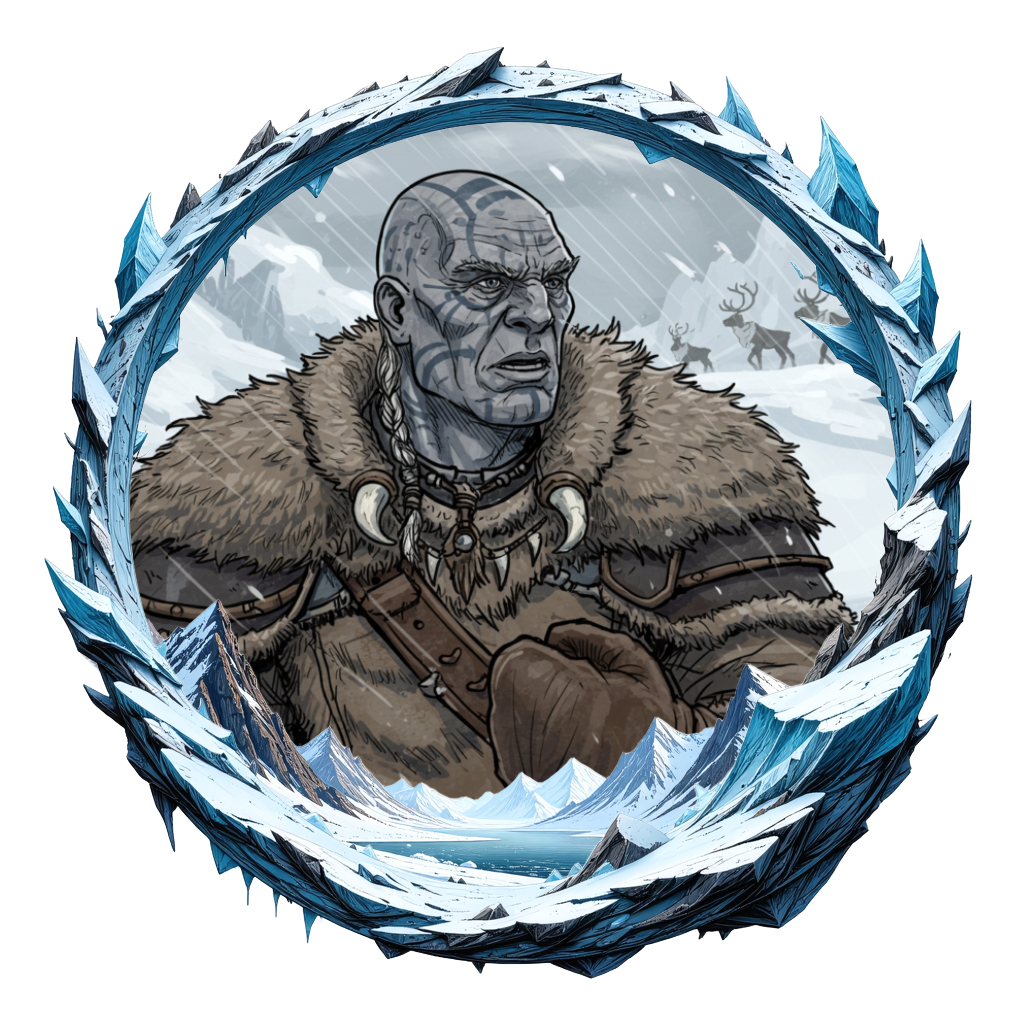 "In Frostreach Territories, cold bites like iron, breath freezes, blood grows heavy. Tundra stretches wide, its silence broken by wind’s grim song and Winter Wolves prowling, eyes sharp as blades. Hrimduraz Hothkarls druids murmur to frost spirits, their fires dim against the dark. Kratophoön minotaurs stalk highlands, axes honed by hate. The Iron Oubliette stands, black stone holding cries of the damned. Dún Briste's ruins whisper of lost pride, banshees keening. Walk wary, stranger—be clad in Yeti fur, bear fire within. Ice claims the weak."